Hebrews: Chapter 2
Historical and Literary Context
Original Setting and Audience: The Epistle is addressed to a community of Jewish Christians, likely in Rome or a major Italian city, during the mid-to-late 60s AD. This group faced a "crisis of belonging" driven by external pressure. In the Greco-Roman world, the refusal to participate in imperial cults or local pagan festivities was often viewed as a rejection of pietas (civic duty). Furthermore, as the distinction between Judaism (a religio licita, or legal religion) and Christianity became sharper, these believers lost the legal protection of the synagogue. They were tempted to "drift" back toward the familiar, safe structures of the Levitical system and the Mosaic Law to avoid persecution and social ostracization.
Authorial Purpose and Role: The anonymous author, a skilled rhetorician and second-generation believer (2:3), writes a "word of exhortation" (13:22). His tone is pastoral yet authoritative. His primary purpose is to prevent apostasy by demonstrating the absolute supremacy of Jesus Christ over all Old Covenant mediators—specifically angels and Moses. He argues that retreating to the "shadows" of the Old Covenant is not a return to safety but a catastrophic rejection of the "substance" found only in the Son.
Literary Context: Chapter 2 functions as the first major pivot in the letter. After the high Christology of Chapter 1, which established the Son’s ontological superiority to angels, the author shifts from the indicative (doctrine) to the imperative (warning). This chapter serves as the "Hermeneutical Key" to the Incarnation: it explains why the exalted Son of Chapter 1 had to become the suffering Mortal of Chapter 2. It links his deity to his necessary humanity, establishing his qualification to be the "Merciful and Faithful High Priest."
Thematic Outline
A. Warning Against Drifting Away (vv. 1-4)
B. The Restoration of Human Dominion Through the Son (vv. 5-9)
C. The Necessity of the Son's Suffering and Solidarity (vv. 10-13)
D. The Victory Over Death and the Merciful High Priest (vv. 14-18)
Exegetical Commentary: The Meaning "Then"
Warning Against Drifting Away (vv. 1-4)
The chapter opens with a crucial logical connector, "Therefore" (dia touto), anchoring the following warning directly to the theological weight of Chapter 1. Because the Son is superior to angels, the obligation to heed his message is absolute. The author commands the audience to "pay the most careful attention" (perissoterōs prosechein). The Greek verb prosechein implies more than active listening; it means to "anchor" or "moor" the mind to a specific truth.
Deep Dive: Pararyōmen (Drifting Away) (v. 1)
Core Meaning: The verb pararyōmen is a nautical term meaning "to flow past," "to slip away," or "to be washed away." It vividly describes a ship that is not tied securely and is silently carried past its harbor by the current. It can also refer to a ring slipping unnoticed from a finger.
Theological Impact: This metaphor redefines the nature of apostasy in this context. It suggests that spiritual failure often begins not with a violent rebellion or intellectual rejection, but with passive negligence. One does not need to row against the truth to be lost; one simply needs to stop rowing.
Context: In the first-century Mediterranean world, currents were a constant, silent danger to unmoored vessels. The metaphor would have resonated deeply with an audience feeling the constant, subtle "pull" of their culture and old religious traditions enticing them away from the scandal of the Cross.
Modern Analogy: Imagine a person on a paddleboard in a slow-moving river. If they stop paddling and lie down to rest, they do not feel like they are moving. However, the current is relentlessly carrying them miles away from safety. By the time they wake up, the "drift" has become a disaster.
In v. 2, the author employs a classic rabbinic argument known as qal wahomer ("light to heavy" or a fortiori). He cites the "message spoken through angels" referencing the Second Temple Jewish tradition (found in the LXX of Deuteronomy 33:2, Acts 7:53, and Galatians 3:19) that angels served as mediators at Sinai. The argument posits: if the Mosaic Law, mediated by servants (angels), was legally binding and every violation received "just punishment" (misthapodosia—a strict settling of accounts), how much more severe is the consequence for ignoring the Son?
v. 3 poses the inescapable rhetorical question: "how shall we escape if we ignore so great a salvation?" The verb "ignore" (amelesantes) suggests treating something of immense value as trivial or unworthy of concern. This salvation was authenticated by a triple witness:
- Origin: It was "announced by the Lord" (Jesus).
- Transmission: It was "confirmed to us by those who heard him" (the apostolic eyewitnesses), indicating the author is a second-generation Christian.
- Validation: "God" himself testified (synepimartyrountos) through "signs, wonders and various miracles, and by gifts of the Holy Spirit..." v. 4.
God's testimony came through "signs, wonders and various miracles" and "gifts of the Holy Spirit." The Greek merismois ("distributions") implies that these spiritual gifts were not random, but strategically apportioned by the Sovereign will to validate the message. In a culture where "wonders" were often attributed to magic or local deities, the author asserts these were the "official seal" of the Creator, proving the transition from the Old Covenant to the New was divinely sanctioned.
Theological Refinement: The Function vs. Cessation of Miracles
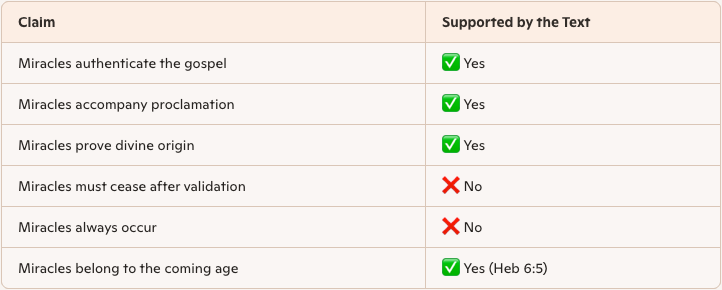
Hebrews 2:4 states that God "testified to it [the message] by signs, wonders and various miracles." The Greek participle synepimartyrountos (testifying at the same time) links the miracles to the act of validation.
The Interpretation: The text explicitly teaches that miracles serve a confirmatory purpose—they accredit the message and the messenger. However, the text does not state that once the message is confirmed, the signs are withdrawn. To claim they ceased is an argument from silence (reading into the text - eisegesis), not an exegetical derivation from this verse.
The "Kingdom" Perspective (Corrected View): Later in Hebrews 6:5, the author describes believers as those who have tasted "the powers of the coming age" (dynameis te mellousēs aiōnos). The phrase "dynameis te mellousēs aiōnos (δυνάμεις τε μέλλουσας αἰῶνος)" refers to eschatological power intruding into the present. Thus, miracles are not merely credentials, they are also manifestations of the age to come braking into the present age.
- If miracles are manifestations of the "Coming Age" (the Kingdom of God) breaking into the present...
- And if we are still living in the "overlap" of the ages (the "Now and Not Yet")...
- Then logically, the "powers" should continue as long as the Kingdom of God is being proclaimed, serving as ongoing evidences of Christ's victory over the present powers of the "evil age" (Kingdom of Darkness).
Revised "Elements of Discontinuity":
- Flawed: "Apostolic Confirmation by Miracles: ...the specific 'confirmation' ... was a unique historical foundation... We now look to the written testimony."
- Nuanced: The Foundational Role of the Apostles: The specific office of the Apostle (as an eyewitness of the resurrected Christ) was unique to the first generation and provided the normative "foundation" (Eph 2:20) for the church. While the canon of Scripture is closed and needs no new confirmation, the text does not require us to believe that God has ceased "testifying" to the reality of His Kingdom, the Kingdom of God, through signs and wonders today. The authority of the message is fixed; the activity of the Spirit remains dynamic.
The Restoration of Human Dominion Through the Son (vv. 5-9)
In v. 5, the author returns to the angelic comparison, asserting that God did not subject "the world to come" (oikoumenēn tēn mellousan) to angels. This "world to come" refers to the inaugurated Kingdom of God, the Messianic age.
Deep Dive: subjected the world to come v. 5
"It is not to angels that he has subjected the world to come, about which we are speaking." (Hebrews 2:5)
"Ou gar angelois hypetaxen tēn oikoumenēn tēn mellousan, peri hēs laloumen. (Hebrews 2:5)
This verse is the hinge of the author's argument. It pivots from the warning about "drifting" (vv. 1–4) to the exposition of Psalm 8 (vv. 6–9). To understand it fully, we have to look at the specific Greek terms and the Jewish worldview the author is referencing.
The "World to Come" (Oikoumenē)
The author does not use the standard Greek word for "world" (kosmos), which often refers to the physical universe or the fallen world system. Instead, he uses oikoumenēn.
- Meaning: Oikoumenē literally means "the inhabited earth" or "the civilized world." It refers to the world of human society, interaction, and governance.
- The Modifier: He adds tēn mellousan ("the coming one" or "the one about to be").
- Significance: He is not talking about "going to heaven" in a disembodied state. He is talking about the Inaugurated Kingdom of God—the renewed creation where God's will is done. This connects directly to the "Kingdom of God." The author is saying: The future civilization of God, which is breaking into the present, is not run by angels.
The "Angelic Administration" (The Background)
Why would the audience think the world was subject to angels?
In Second Temple Judaism and the Old Testament background (specifically the Septuagint/Dead Sea Scrolls reading of Deuteronomy 32:8 and Daniel 10), there was a belief that God had assigned the nations of the current age to the administration of angelic beings (the "sons of God").
- Angels were viewed as the "middle management" of the cosmos.
- They governed the nations (e.g., the "Prince of Persia" in Daniel 10:13).
- They mediated the Law (Galatians 3:19).
The Author's Point: The "Old Age" (the time of the Law) was administered by angels. But the "Age to Come" (the Kingdom of God) marks a change in management. God has not given the keys of the Kingdom to angels.
The Shift to Human Dominion
By denying angelic rule over the "world to come," the author is setting the stage for the radical elevation of humanity.
- If angels aren't in charge of the future, who is?
- This forces the reader to ask: Who then is the ruler?
- The answer (provided in vv. 6–9) is Man (Humanity), but specifically the Representative Man, Jesus.
The author is essentially arguing:
"Look, the previous era—the era of Sinai and the Law—was mediated and governed by angels. That is why you respect them. But we are speaking about the New Era, the Kingdom of God. In this new administration, angels are 'ministering spirits' (1:14). The throne of this new world belongs to a Human—the Son—and by extension, to the humans He redeems."
This is why the Incarnation (becoming human) was necessary. To rule the "World to Come," Jesus couldn't just remain the eternal Logos; He had to become the Human King because God ordained that humanity, not angels, would rule the world.
vv. 6-8 cites Psalms 8:4-6 to define the intended status of humanity. The author notes that God made humans "a little lower than the angels" yet "crowned them with glory and honor," putting "everything under their feet." Originally, this Psalm celebrated the dominion mandate given to Adam. However, the author identifies a tragic tension in v. 8: "at present we do not see everything subject to them." The text acknowledges the fracture of the cosmos; humanity is currently a slave to the creation it was meant to rule, subject to decay and death.
v. 9 provides the Christological resolution to this anthropological crisis: "But we do see Jesus."
Deep Dive: Brachy Ti (Lower than the Angels) (vv. 7, 9)
Core Meaning: The Greek phrase brachy ti is ambiguous and can mean either "for a little while" (temporal) or "by a small amount" (degree/rank).
Theological Impact: The author exploits this ambiguity. In the context of creation (v. 7), it likely refers to rank—humans are ontologically "lower" than celestial beings. In the context of Christ (v. 9), it becomes temporal. Christ accepted the "lowering" of the Incarnation only for a season. This highlights the kenosis (emptying)—He did not lose His divinity but voluntarily entered a station of functional subordination to accomplish redemption.
Context: In the Greco-Roman "Great Chain of Being," movement was strictly hierarchical: Gods > Daemons/Angels > Humans > Animals. For a Divine Being to voluntarily move "down" the chain was considered moria (foolishness) to the pagan mind. The author flips this, presenting the descent as the only path to true Glory.
Modern Analogy: Think of a high-ranking General who removes his insignia to enter a combat zone as a private. He has not lost his rank or authority, but he has temporarily assumed a "lower" status to lead his troops from the front lines.
The purpose of this lowering was specific: "so that by the grace of God he might taste death for everyone." The phrase "taste death" (geusētai thanatou) is a Semitic idiom implying a full, visceral experience of reality. Jesus did not merely appear to die; he drank the cup of mortality to the dregs. The text establishes the "Paradox of the Cross": Jesus is crowned with glory and honor because he suffered death. His exaltation is not in spite of his suffering, but the direct result of it. He is the Second Adam who regains the lost dominion of the First.
The Necessity of the Son's Suffering and Solidarity (vv. 10-13)
The Pioneer of Salvation (v. 10)
The author anticipates a potential objection: How could a suffering, crucified Messiah be the "Glory" of God? He answers that it was "fitting" (eprepen) for God—the one for whom and through whom everything exists—to do this. The term eprepen is aesthetically and logically weighted; it suggests that the Cross was not a tragic accident or a "Plan B," but was entirely consistent with God's character and the demands of cosmic justice.
To bring "many sons and daughters to glory," God made the "pioneer of their salvation perfect through what he suffered." The verb "perfect" (teleiōsai) does not imply moral improvement (as if Jesus were sinful), but "functional completion" or "qualification." Just as a doctor is "perfected" by passing their boards and residency, Jesus was fully qualified as the Savior only by enduring the human experience of suffering.
Deep Dive: Archēgos (Pioneer/Captain) (v. 10)
Core Meaning: Archēgos is a rich compound word combining archē (beginning/rule) and agō (to lead). It refers to a "founder," "path-breaker," "captain," or "hero."
Theological Impact: Jesus is not merely the source of salvation; He is the Leader who goes first. He enters the hostile territory of death, cuts a path through it, and emerges on the other side, creating a wake for others to follow. He is the "Firstborn" who secures the safety of the entire family.
Context: In Greek mythology and civic life, an archēgos (like Heracles or a city founder) was a hero who performed great labors to establish a community or save a people. The author "baptizes" this concept: Jesus is the Greater Hero whose "labor" was the Passion, founding the City of God.
Modern Analogy: Think of an elite mountaineer (the archēgos) who scales a previously unclimbed, vertical ice wall. He goes up alone, facing the danger first, to fix the ropes. Once the ropes are secure, the rest of the team can ascend safely. They still have to climb, but the path has been opened by the Pioneer.
Familial Solidarity (vv. 11-13)
In v. 11, the author establishes the ontological basis for salvation: "solidarity." Both the Sanctifier (Jesus) and the sanctified (believers) are "of the same family" (literally "from one," ex henos). Because of this shared humanity, Jesus is "not ashamed to call them brothers and sisters." In the honor-shame culture of the ancient world, for a Superior (the Divine Son) to publicly claim kinship with the Inferior (suffering, mortal humans) was a radical act of social condescension and grace.
vv. 12-13 validate this claim with three Old Testament citations, placing the words of the prophets into the mouth of Jesus:
- Psalm 22:22: "I will declare your name to my brothers..." This connects Jesus to the suffering Davidic King who, after his trial, praises God in the midst of the assembly.
- Isaiah 8:17: "I will put my trust in him." This presents Jesus as the model believer, trusting God through the darkness of death.
- Isaiah 8:18: "Here am I, and the children God has given me." This presents Jesus as the Guardian of the new community.
The Victory Over Death and the Merciful High Priest (vv. 14-18)
The Defeat of the Devil (vv. 14-16)
v. 14 explains the mechanics of the Incarnation. Since the "children" possess "flesh and blood," Jesus "shared in their humanity" (meteschen)—he partook of the same biological reality. The purpose was forensic and military: "so that by his death he might break the power of him who holds the power of death—that is, the devil."
The Greek verb katargēsē means to "render inoperative," "defang," or "make powerless," rather than to annihilate. The devil’s "power of death" was not sovereign control (which belongs to God alone) but the power of accusation. By holding the law against sinful humanity, the Accuser wielded death as a legal executioner. When Christ paid the debt, he disarmed the Accuser.
Deep Dive: Hebrews 2:14 — Explanation and Theological Significance
"Since the children have flesh and blood, he too shared in their humanity so that by his death he might break the power of him who holds the power of death—that is, the devil—" (Hebrews 2:14)
Why did the Omnipotent God have to become a fragile baby? He needed a body so He could die.
The Currency: "Flesh and Blood"
The text says the children (us) share in "flesh and blood" (haimatos kai sarkos). This implies frailty, mortality, and biological limitation.
- The Problem: God is Spirit. He is immortal. He literally cannot die.
- The Mission: To defeat death, God had to enter the territory of death.
- The Solution: He "shared in" (meteschen) our humanity. The Greek verb implies actively taking hold of something that is not naturally yours. He wrapped His immortality in mortality. He took on a body specifically so it could be broken.
- The Logic: You cannot pay a debt of "death" if you don't have a life that can end. "Flesh and blood" was the currency required to pay the ransom.
The Enemy's Weapon: "The Power of Death"
The verse says the devil holds the "power" (kratos) of death. This is often misunderstood.
- What it is NOT: The devil is not the Lord of Life and Death. He cannot kill whomever he wants; only God determines the span of a life (Deuteronomy 32:39).
- What it IS: The "power" here is Legal Authority (the devil is the Accuser).
- The Chain: Sin leads to Death (Romans 6:23). The Law gives Sin its power (1 Corinthians 15:56).
- The Devil's Role: He is the Prosecutor. As long as humanity is guilty of sin, the devil has the legal right to demand their execution. He "holds" the power of death like a jailer holds a key—not because he owns the jail, but because he has the warrant for the prisoner.
The Divine Trap: "By His Death"
The devil likely thought that killing the Son of God would be his ultimate victory. Instead, it was his undoing.
- The Trap: By killing a man who had no sin, the devil overstepped his legal authority.
- The Payment: Simultaneously, Jesus used that death to pay the debt of "the children."
- The Result: If the debt is paid, the warrant is cancelled. If the warrant is cancelled, the jailer has no authority to hold the prisoners.
By dying, Jesus stripped the devil of the only weapon he had: our guilt.
The Destruction: "Break the Power" (Katargēsē)
The translation "destroy" is too strong, and "break" is too weak. The Greek verb is katargeo.
- Literal Meaning: To render inoperative, to make idle, to unplug, or to "de-activate."
- Nuance: The devil still exists. Death still happens physically. But the system has been deactivated.
- Jesus has "defanged" the snake. It can strike, but it has no poison (the sting of death is sin, 1 Cor 15:56, and that sin is covered).
The Logic of the Atonement
In Hebrews 2, the author provides two specific mechanisms for how "One" (Jesus) can pay for "Many" (His children). It relies on Representation and Value.
The Principle of Representation (The "Head" Argument)
In the modern West, we are hyper-individualists. We think, "I am responsible for me, and you are responsible for you."
But in the ancient world (and in the Bible), they understood Corporate Solidarity. This is the idea that a Leader (a Head) acts on behalf of the entire group.
- The Adam Parallel: The Bible teaches that Adam was the "Head" of the human race. When he failed, he didn't just fail for himself; he failed as the Representative of humanity. He bankrupted the family business, so everyone born into the family is born into debt.
- The Second Adam (Jesus): Hebrews 2:10 calls Jesus the Archēgos (Pioneer/Captain). He is the new Head of a new family (v. 13 "the children God has given me").
- The Logic: Because He is the new Head, His action counts for the whole body. Just as a President signs a treaty and the entire nation is at peace, Jesus signed the treaty in His blood, and His children are at peace.
The Principle of Infinite Value (The "Diamond" Argument)
This addresses the math: How can one human life equal the value of billions of human lives?
If Jesus were merely a sinless human (like a second Adam only), his death might theoretically pay for one other person (a life for a life). But Hebrews 1 establishes that Jesus is God ("the radiance of God's glory").
- The Math of Deity: Because Jesus is God, His life has infinite intrinsic value.
- The Analogy: Imagine you have a debt of 10 billion dollars (the sin of the world).
- If 10 billion people each chip in a penny (human effort), it's not enough.
- If a friend offers a single penny (a mere human life), it pays for almost nothing.
- But if a King places a single diamond worth 100 trillion dollars on the counter, it pays the entire debt instantly—not because there are many diamonds, but because the quality of that one diamond exceeds the value of the debt.
Jesus' death pays for everyone because:
- He is Human (v. 14): So the payment is in the right currency (blood).
- He is God (Hebrews 1:3): So the payment has infinite value.
- He is the Captain (v. 10): So the payment is legally applied to His "team."
v. 15 describes the result: the liberation of those "held in slavery by their fear of death." In the ancient world, death was the "King of Terrors," an omnipresent master. The Gospel is presented here as an emancipation proclamation, freeing humanity from the existential dread that drives much of human behavior.
v. 16 clarifies the scope: this rescue mission is not for angels (who fell without redemption) but specifically for "Abraham’s descendants"—the covenant family of faith.
The Merciful High Priest (vv. 17-18)
v. 17 is the climax of the chapter's argument. Jesus had to be made like his brothers "fully human in every way" (not just partially) to become a "merciful and faithful high priest." This is the first mention of his High Priestly office.
- Merciful: Toward the people (because He understands their weakness).
- Faithful: Toward God (because He perfectly fulfills the divine requirement).
His task was to "make atonement" for the sins of the people.
Deep Dive: Hilaskesthai (Atonement/Propitiation) (v. 17)
Core Meaning: To propitiate, to appease, or to make an offering that removes the cause of offense. It refers to the removal of wrath and the covering of sin.
Theological Impact: This term moves the argument from "solidarity" to "sacrifice." It describes the dual action of the Cross: expiating (wiping away) the guilt of sin and propitiating (satisfying) the holy justice of God. In Hebrews, Jesus is unique because He is both the Priest who performs the rite and the Victim who provides the blood.
Context: In the Old Testament (LXX), this word group is associated with the kapporet or "Mercy Seat" (Leviticus 16), where blood was sprinkled on the Day of Atonement to cover the sins of Israel and avert judgment.
Modern Analogy: Imagine you owe a massive, unpayable debt to a strict bank, and facing prison. A wealthy benefactor doesn't just ask the bank to "let it slide" (which would be unjust); he walks in and pays the debt in full. The bank's claim against you is "propitiated"—satisfied—and your legal standing is restored.
v. 18 concludes with the practical application: "Because he himself suffered when he was tempted, he is able to help those who are being tempted." The Greek word for "help" (boēthēsai) is evocative; it literally means "to run to the cry of." It describes someone who hears a shout for help and rushes to the scene. Christ’s empathy is not theoretical; it is the visceral response of a veteran soldier running to aid a comrade in the trenches.
The Hermeneutical Bridge: The Meaning "Now"
Timeless Theological Principles
- The Law of Spiritual Drift: Spiritual apostasy is rarely a sudden leap but a gradual, passive drift caused by neglecting to "anchor" oneself in the Word.
- The Necessity of Incarnation: True mediation requires total identification. God could not save humanity from a distance; He had to enter the human condition to heal it.
- The Defeat of Fear: The fear of death is the root of spiritual slavery. By defeating death, Christ breaks the psychological power of the enemy over the believer.
- The Empathy of God: God’s response to human struggle is not cold judgment but active, experiential empathy. He knows the weight of temptation because He carried it.
Bridging the Contexts
Elements of Continuity (What Applies Directly):
- The Warning Against Neglect: The command to "pay the most careful attention" is universally applicable. In an age of digital distraction, the "current" pulling believers away from the Gospel is stronger than ever. The antidote remains the same: active, anchored attention to what we have heard.
- Access to the High Priest: The promise of v. 18 applies directly to every believer's prayer life. We can approach Jesus with our temptations not with shame, but with the confidence that He "feels" the struggle and is ready to "run to our cry."
- Freedom from Death Anxiety: While modern culture masks death with medicalization, the Gospel remains the only cure for the existential dread of non-existence. The believer is called to live with a distinct fearlessness regarding mortality.
Elements of Discontinuity (What Doesn't Apply Directly):
- Angelic Mediation of Law: The specific first-century theological debate regarding the Torah being "spoken by angels" is a product of Second Temple Judaism. While we accept the principle that the Son is greater than all previous messengers, modern believers do not generally view angels as the primary authors of their ethical code.
- The Language of Ritual Priesthood: The terms "High Priest" and "Atonement" rely on the framework of the Levitical system and the physical Temple, which no longer exists. We apply these truths theologically (Christ is our access), but we do not look for a physical priest to mediate for us or offer animal sacrifices.
- Slavery to the Devil as "Law-Holder": The specific legal/forensic imagery of the devil holding the "power of death" through the Old Covenant law is a unique redemptive-historical argument. While the devil remains the tempter, his power to accuse the believer using the Mosaic Law has been historically nullified.
Christocentric Climax
The Text presents The Shadow of the Enslaved King. In Psalm 8, humanity is crowned with glory and honor, commissioned to rule the cosmos. Yet, the text reveals a tragic reality: this King is in chains. Humanity is a monarch in exile, enslaved by the fear of death, subject to decay, and lower than the very angels we were meant to judge. We see a crown we cannot reach and a creation that rebels against us.
Christ provides The Restoration of the Crown. He does not merely pity the exiled kings; He becomes one. By stepping down into the "lower" state of flesh and blood, He enters the prison house of death. But unlike Adam, He cannot be held. He breaks the power of the Warden (the devil) from the inside out. In His resurrection, He emerges as the Archēgos—the Pioneer who retrieves the lost crown of humanity and places it back on the head of His redeemed family, leading them out of the slavery of fear and into the glory of the World to Come.
Key Verses and Phrases
Hebrews 2:1
"We must pay the most careful attention, therefore, to what we have heard, so that we do not drift away."
Significance: This establishes the primary danger of the Christian life: not rebellion, but drift. It provides the central metaphor for spiritual maintenance—anchoring the mind in the Truth against the constant, subtle currents of the world.
Hebrews 2:14-15
"Since the children have flesh and blood, he too shared in their humanity so that by his death he might break the power of him who holds the power of death—that is, the devil—and free those who all their lives were held in slavery by their fear of death."
Significance: This is the definitive statement on the "why" of the Incarnation. It frames the Atonement as a rescue mission (Christus Victor), identifying the fear of death as the primary weapon of the enemy and Christ's death as the strategic counter-move that disarmed him.
Hebrews 2:18
"Because he himself suffered when he was tempted, he is able to help those who are being tempted."
Significance: This verse revolutionizes the concept of God. It transforms the Divine from a distant Judge into a sympathetic Ally. It assures the believer that the help they receive in temptation comes from a Savior who has felt the full weight of the battle and remained standing.
Concluding Summary & Key Takeaways
Hebrews 2 serves as the essential bridge between the Divine Son of Chapter 1 and the High Priest of Chapter 3. The author argues that the Son's superiority is not diminished by his humanity; rather, his humanity was the necessary condition for his victory. By becoming "lower than the angels" for a time, Jesus was able to taste death for everyone, destroy the devil's power, and qualify himself to be the compassionate Pioneer of a new humanity. The chapter stands as a warning against spiritual lethargy and a comfort to those battling fear and temptation.
- Drift is Dangerous: The greatest threat to faith is often a slow, imperceptible slide caused by a lack of attention to the Gospel.
- The Paradox of Glory: True glory and dominion are achieved not through seizing power, but through suffering and sacrificial service, as modeled by the Pioneer, Jesus.
- Death is Defeated: The fear of death is no longer a valid master for the Christian; Christ has broken its power and removed its sting.
- You Are Not Alone: In every temptation, believers have immediate access to a High Priest who understands the struggle intimately and runs to their aid.