Ezekiel: Chapter 43
Historical and Literary Context
Original Setting and Audience: Ezekiel was a priest by birth and a prophet by calling. In 597 BC the Babylonian army carried him off to exile along with King Jehoiachin and the first wave of Judah's ruling class. He prophesied to a community of deportees settled along an irrigation canal called the Kebar, hundreds of miles from Jerusalem. The great temple vision that fills chapters 40–48 carries a precise date: the twenty-fifth year of the exile, roughly 573 BC. That places it about fourteen years after the Babylonian king Nebuchadnezzar II leveled Jerusalem and burned the temple in 587/586 BC. The audience, then, is a people in shock. They had lost the three anchors of their identity in a single blow—the land promised to Abraham, the throne of David, and the temple where God's presence lived. The dominant superpower is the Neo-Babylonian Empire, and in covenant terms the exiles are living inside the worst-case scenario the Law of Moses had spelled out. Deuteronomy 28 and Leviticus 26 had warned that stubborn covenant-breaking would end in expulsion from the land. That curse has now fallen in full. Worse still, in Ezekiel's earlier visions the kavod—the visible glory, the weighty presence of God—had abandoned the temple and moved eastward out of the city (chapters 8–11). This meant the exiles faced not merely political defeat but the departure of God himself. Chapter 43 is the direct answer to that trauma.
Authorial Purpose and Role: Here Ezekiel serves as a proclaimer of restoration, yet his priestly instincts remain fully awake. His purpose is to comfort a devastated people by showing that the divine presence will return—but the comfort arrives wrapped in a call to holiness and even to shame (v. 10). He is no longer chiefly the covenant-lawsuit prosecutor of the book's first half, indicting Judah for its guilt. He has become a visionary architect, receiving and recording the blueprint of a purified sanctuary where God can dwell without ever again being defiled. His role fuses three offices: seer, scribe, and priestly lawgiver.
Literary Context: Chapter 43 is the theological summit of the entire final vision (chapters 40–48). Chapters 40–42 are pure measurement. The heavenly guide walks Ezekiel through gates, courts, and chambers with a measuring rod, cataloging an empty structure down to the cubit. That emptiness is the whole point. A house is not yet a home until its owner moves in. Chapter 43 supplies the occupant. The glory that departed in chapters 8–11 now returns, and the vision pivots from architecture to indwelling. Everything that follows depends on this return: the sealed east gate (44), the duties of the priests and the prince (44–46), the sacrificial calendar, and the river of life flowing out from beneath the temple (47). This chapter is the hinge on which the book's entire hope turns.
Thematic Outline
A. The Return of the Glory to the Temple (vv. 1-5)
B. The LORD's Declaration of His Eternal Dwelling (vv. 6-9)
C. The Command to Describe the Temple for Shame and Instruction (vv. 10-12)
D. The Measurements of the Altar (vv. 13-17)
E. The Consecration and Atonement of the Altar (vv. 18-27)
Exegetical Commentary: The Meaning "Then"
The Return of the Glory to the Temple (vv. 1-5)
Brought to the Eastern Threshold (v. 1)
The chapter opens with movement. Ezekiel writes, "Then the man brought me to the gate facing east." The "man" is the bronze-gleaming heavenly guide who has spent three chapters measuring the visionary temple, rod in hand. Until now the tour has been silent and architectural—walls, gates, chambers, and courts, all precisely dimensioned and completely empty. A flawless blueprint with no one living inside it. The guide now stations Ezekiel at the east gate, and the direction is loaded with meaning.
East is the direction the glory took when it left. In the earlier judgment vision, the presence of God rose from above the Most Holy Place, paused at the threshold, moved to the east gate, and finally lifted off the city to rest on the mountain east of Jerusalem (Ezekiel 10:18–19; 11:22–23). The exit route ran eastward. So when the guide places Ezekiel at the east gate to watch, the attentive reader already senses what is coming. The presence that walked out this door is about to walk back in through it. The chapter's opening posture is not random staging; it positions the prophet at the exact wound, facing the exact direction of the loss.
The Glory from the East and the Voice of Many Waters (v. 2)
Then the horizon breaks open. "And I saw the glory of the God of Israel coming from the east." Everything measured across the previous three chapters—every gate, every wall, every silent and empty court—was only the setting for this. The One for whom the house was built now comes to fill it, and the prophet's language strains at its limits, because what approaches cannot be held inside ordinary words. What Ezekiel witnesses is a theophany, a visible breaking-in of God himself into the created world, and it arrives through two channels at once: sound and light.
First the sound. "His voice was like the roar of rushing waters." The Hebrew is qol kemayim rabbim, "a voice like many waters"—not a loud voice but a voice with no edges, the sound of a waterfall in full flood, of the open sea driven before a storm. It is a sound felt in the chest before the mind can shape it into words, a sound that leaves no silence anywhere for anything else to be heard. Every competing voice—the murmur of the exiles, the noise of Babylon, the prophet's own racing thoughts—is simply drowned beneath it. This is not a God straining to be heard over rivals. When he speaks, there is room for nothing but him.
Then the light. "the land was radiant with his glory." Notice what is lit. Not a lamp, not a contained shining at the gate, but the land itself—the ground catching fire with a brightness borrowed from the One who arrives, until the whole earth blazes with a glory that is not its own. There is no shadow left to stand in, no dim corner to withdraw into, no neutral ground from which a person might observe at a safe distance. The approaching glory floods the world with light exactly as the voice floods it with sound, and the effect is identical: total, inescapable, leaving the creature nowhere to be but exposed and undone.
This is the force carried by the word kavod, "weight" or "heaviness." The glory is not a description of God or a symbol pointing toward him from a distance; it is the sheer mass of who he is, the unbearable nearness of God himself pressing down upon the created order until the created order can barely hold him. Weight is the fitting word, because glory bears down. And this is why, in the very next verse, Ezekiel does not bow as an act of courtesy—he falls. The body has no other option under a weight like this. A landscape set ablaze and a voice like the sea are not scenery arranged for effect; they are the fitting arrival of the God who fills heaven and earth, and the only possible response, from prophet and reader alike, is to be brought to the ground.
Deep Dive: The Glory (Kavod) of the LORD (v. 2)
Core Meaning: The Hebrew word behind "glory" is kavod, built on a root that means "heaviness" or "weight." God's glory is his manifest presence—the sheer weight of who he is—breaking into the physical world as fire, cloud, and blinding light. It is not a picture or emblem of God standing in for him. It is the felt density of God himself, made perceptible to human senses.
Theological Impact: Because kavod is presence and not merely a symbol, its arrival changes everything it touches. Where the glory settles, that ground is no longer ordinary; it becomes the throne room of heaven pressed down onto the earth, holy for one reason only—because he is there. This is why Israel's entire theology of the temple rests on a single fact: the building matters only because the kavod consents to live inside it. Strip the presence away and nothing remains but costly stone, a magnificent shell with no one home. And this is why the departure of the glory in chapters 8–11 was the true catastrophe of the exile, a wound cut deeper than the loss of the land or the toppling of the walls. Babylon could burn the house, but the house was already empty. The unspeakable loss was never the building. It was the One who had walked out of it.
Context: The same kavod filled the wilderness tabernacle at its dedication, so densely that Moses could not enter (Exodus 40:34–35). It later filled Solomon's temple at its dedication, so that the priests could not stand to minister (1 Kings 8:10–11). Ezekiel is deliberately reaching for that memory. What the exiles lost, he is announcing, God intends to restore in even greater fullness.
Deep Dive: The Departure and Return of the Glory (v. 2)
Core Meaning: This is the master storyline of the entire book of Ezekiel—the exile of God's presence, followed by its homecoming. It is a systemic framework, not a single image, and it organizes the whole prophecy from beginning to end.
Theological Impact: Ezekiel refuses the popular assumption of the age, which held that a nation's god was chained to its temple and city. By that logic, when Jerusalem fell, its God was either defeated or destroyed. Ezekiel dismantles this entirely. He shows God freely choosing to withdraw as an act of judgment, and just as freely choosing to return as an act of grace. The presence was never captured. It left on its own terms, and it comes back on its own terms. This reframes the whole disaster. The exiles were not abandoned by a weak God but disciplined by a sovereign one who always intended to come home.
Context: In chapters 8–11 Ezekiel watched the glory leave in stages, step by reluctant step, out the east gate and onto the eastern mountain. The pacing itself communicated grief, as though the presence were slow to go. Now, in chapter 43, that motion reverses with exact symmetry. The presence retraces its own steps and enters by the very gate through which it departed. The reversal is precise and intentional. The exile of God is over.
The Vision of Judgment Recalled (v. 3)
Before Ezekiel tells us how he responded, he pauses to say what the vision was like, and the comparison he chooses is unsettling. "The vision I saw was like the vision I had seen when he came to destroy the city and like the visions I had seen by the Kebar River." Read that slowly, because it is stranger than it first looks. This is the great vision of comfort—the homecoming of God, the healing of the exile's deepest wound. Yet to describe it, Ezekiel reaches back and binds it to the most terrifying thing he had ever witnessed: the vision of God arriving to destroy Jerusalem. He lets the smoke of the burning city drift straight across the brightness of this moment. Why? Why tie the return of mercy, of all things, to the memory of judgment?
Because it is the same God—and the exiles needed that truth far more than they needed a gentler, unrelated picture. The glory now returning is not some softened deity who has learned to be kind in the years since the fire. It is the identical holy weight that rose from above the Most Holy Place, moved to the gate, and handed the city over to be burned. The same throne-chariot Ezekiel first saw wheeling above the Kebar canal in chapter 1. The same glory that withdrew in judgment in chapters 8–11. One God, one chariot-throne, one unbroken act of self-revelation stretching across the whole book—from the vision of calling, through the vision of destruction, to this vision of return. That continuity is at once the comfort and the warning. The God coming home in mercy is the very God who was always holy enough to leave. And the mercy carries no weight at all unless it is the mercy of that God.
There is a further tremor buried in the Hebrew. The written consonants of the phrase read, "when I came to destroy the city," placing the prophet himself beside God as an agent of the judgment—because the prophetic word he had spoken was part of the very instrument that carried it out. Most translations, the NIV included, smooth this to "when he came," keeping the focus squarely on God. But the harder reading leaves a shadow worth feeling: to have spoken God's word of judgment was, in some real sense, to have shared in its execution.
Then comes the response, and after everything the previous verses have built, it is the only response left. "And I fell facedown." This is not a bow. A bow is a decision, a courtesy one chooses to extend. Ezekiel does not choose. Under a voice like flooding waters and a land ablaze with the weight of God, the body simply gives out—the knees buckle and the face goes to the ground, because a creature cannot stay standing beneath a glory like this. It is the same collapse that ended the Kebar vision (Ezekiel 1:28) and the same posture the glory drove him to before (Ezekiel 3:23). It marks the exact border between reverent nearness and casual familiarity. And there is a quiet purpose in it: the prophet who is about to be lifted up and handed the most detailed revelation in the book must first be brought all the way down. Before God commissions him, he flattens him.
Deep Dive: The Kebar River Vision (v. 3)
Core Meaning: The Kebar (or Chebar) was a large irrigation canal in Babylonia near the city of Nippur. It was the site of Ezekiel's inaugural vision in chapter 1—the famous sight of a storm-cloud throne carried on wheels within wheels and borne by four living creatures. Scholars often call this the merkabah, the Hebrew word for "chariot," referring to God's mobile throne.
Theological Impact: The mobility of that throne was the theological breakthrough. A throne on wheels can travel anywhere, which means God is not confined to Jerusalem and can be present with his people even in the heart of a pagan empire. That single truth sustained the exiles through their darkest years. By tying the return of the glory back to the Kebar vision, Ezekiel signals continuity. The God who found them beside a Babylonian ditch is the same God now filling the restored temple.
Context: For an exile living beside that very canal, this reference struck close to home. The revelation had not begun in a sacred sanctuary but in the mud of a foreign work-camp. Ezekiel reminds his fellow deportees that their location never disqualified them from God's attention, and that the whole arc—from Kebar to the new temple—is one unbroken act of the same God.
The Glory Fills the House (vv. 4-5)
The return now reaches its goal. "The glory of the LORD entered the temple through the gate facing east." The circle closes, and it closes exactly. The same glory, the same gate, the same threshold—only the direction reversed. What withdrew eastward in grief now enters from the east in return, retracing step for step the path of its own departure, as though the long years of absence were being unwound before the prophet's eyes. Then Ezekiel is lifted from the ground where he had fallen: "Then the Spirit lifted me up and brought me into the inner court." The Hebrew ruach (Spirit, wind, breath) carries him where his own legs could not, drawing him past the outer courts into the heart of the sanctuary, near enough to see the thing the whole vision has been straining toward.
And then it happens. "and the glory of the LORD filled the temple." The verb "filled" is not chosen loosely, and its weight comes from the two great moments it deliberately recalls. When the tabernacle was finished in the wilderness, the glory came down so densely that Moses himself could not enter (Exodus 40:35). When Solomon's temple was dedicated, the glory poured in so thickly that the priests could not stand to perform their service (1 Kings 8:11). "Filled" is the word for a presence that leaves no room—that saturates a space until nothing common can remain in it and no creature can stand upright before it. That is what now floods the empty blueprint of chapters 40–42. Every silent chamber, every measured court, every vacant threshold is drowned in the living God. The house has received its owner at last.
Sit for a moment in the scale of the reversal. The book opened with a glory that rose, paused, and left, abandoning a defiled house to the fire. It now closes its long arc with that same glory returning to fill a house purified to receive it. What was measured cold and stone by stone is radiant now with the weight of God. The exile of the presence—begun in grief back in chapter 10, endured through every year beside the Kebar canal—ends here. Not with an argument, not with a promise, but with a sight: the house of God ablaze with the God who has come home. Nothing that follows in the vision—not the altar, not the sealed gate, not the river of life running out from beneath the threshold—means anything apart from this. First the presence returns. Everything else is the consequence of a God who came back.
The LORD's Declaration of His Eternal Dwelling (vv. 6-9)
A Voice from Inside the House (v. 6)
For the whole vision up to this point, the heavenly guide has done the talking—measuring, pointing, explaining. Now the speaker changes. "While the man was standing beside me, I heard someone speaking to me from inside the temple." The guide falls silent and steps aside. The voice now issues from within the sanctuary itself, from the very place the glory has just filled. This is a deliberate shift in authority, and it matters. The tour guide gives way to the Occupant. God, having taken up residence, now speaks for himself about the terms of his own dwelling. The logical hinge is clean: only once the presence has entered (vv. 4–5) can the presence lay down the conditions for staying (vv. 6–9). Occupation precedes legislation.
The Throne and the Footstool (v. 7)
The divine speech opens with a claim of ownership. "Son of man, this is the place of my throne and the place for the soles of my feet." The title "son of man" (Hebrew ben adam, simply "human being" or "mortal") is God's standard way of addressing Ezekiel across the book. It keeps the prophet's frailty in plain view even as he stands inside the presence of infinite weight. The heart of the verse, though, is the throne-and-footstool image, which must be unfolded before the warning that follows it.
Deep Dive: The Throne and the Soles of My Feet (v. 7)
Core Meaning: In the ancient Near East, a great king sat enthroned with his feet resting on a footstool. The footstool was not decoration. It marked the zone of the king's immediate authority, the ground he personally dominated. To name a place the "footstool" of a deity was to declare that this exact spot was where heaven's rule touched down onto the earth.
Theological Impact: By calling the temple both his "throne" and the place for "the soles of his feet," God fuses two ideas that we tend to hold apart. The throne says he reigns from here. The footstool says he is truly, bodily present here—not governing from a safe distance but planting his feet in the midst of his people. The whole cosmos is his kingdom, yet this is the throne room where that kingship becomes tangible and local. It is sovereignty and nearness spoken in a single breath.
Context: Israel's older writings already used this exact language. The ark of the covenant was pictured as God's footstool (1 Chronicles 28:2; Psalm 132:7), and Isaiah heard God call heaven his throne and the earth his footstool (Isaiah 66:1). Ezekiel draws on this deep well of tradition to declare that the restored sanctuary is once again the meeting point of divine rule and divine nearness.
The presence-language here is best carried by the Hebrew itself rather than by any modern comparison, because what is at stake is the mystery of God's nearness. The declaration states the goal of the entire vision: "This is where I will live among the Israelites forever." The verb translated "live" is shakan, "to settle" or "to dwell"—the same root that later gave Jewish tradition the word Shekhinah, the settled, resident presence of God. This is not the language of a visit. It is the language of permanent tenancy. That single word carries the freight the exiles most needed to feel: God is not passing through; he is moving in to stay.
Yet in the same breath God attaches a condition of holiness. "The people of Israel will never again defile my holy name—neither they nor their kings—by their prostitution and the funeral offerings for their kings at their death." Two defilements are named. The first is "prostitution," and in Ezekiel's hands this is no mild figure of speech. He is the prophet who, more than any other, cast the covenant as a marriage and idolatry as adultery—developing the image across two long, deliberately scandalous chapters (Ezekiel 16 and 23) in which Jerusalem is portrayed as a bride who betrays her husband. The Hebrew word carries the sense of harlotry, of selling oneself. And Ezekiel sharpens it past ordinary unfaithfulness: his Jerusalem does not merely stray, she pays her lovers, lavishing on foreign gods and foreign alliances the very gifts her husband had given her. To the original audience this was meant to sting and to shame. Their worship of other gods was not a private religious preference or a bit of cultural borrowing; it was marital treachery against the God who had bound himself to them in covenant love. The second defilement is stranger and more concrete, and it points to a specific abuse tied to the old temple's location.
Deep Dive: The Funeral Offerings / Corpses of the Kings (v. 7)
Core Meaning: The NIV reads "funeral offerings for their kings at their death," but the underlying Hebrew phrase, pigrei malkeihem, is difficult and can also be rendered "the corpses of their kings." Interpreters divide into two main readings. Either this refers to a royal cult of the dead—memorial rites and offerings made to deceased kings, treating them as near-divine—or it refers to the literal burial of kings in tombs placed right up against the temple precinct.
Theological Impact: Either way, the offense is identical. Israel's monarchy blurred the boundary between the holy and the unclean. A corpse was the most severe source of ritual impurity in Israel's law (Numbers 19). To honor dead kings with rites, or to entomb them beside the sanctuary, was to press death and idolatry directly against the wall of the God who is the living source of all life. It contaminated the one place meant to be absolutely set apart.
Context: The kings of Judah were in fact buried in the "City of David," on the same ridge as the temple complex, with only a wall separating the royal tombs from sacred ground. Several kings also imported foreign cults and even installed idols inside the temple itself (2 Kings 21). This is no abstract complaint. God is naming a real architectural and religious scandal—the palace, the tombs, and the sanctuary crowded together until the sacred and the profane bled into one another.
Deep Dive: Defiling God's Holy Name (v. 7)
Core Meaning: In Hebrew thought a name (shem) is far more than a label. It is the self made public—a person's character, reputation, and renown projected out into the world where others can see it. To "defile" or profane God's name (the verb is chalal, "to treat as common, to drag down") is therefore not to misuse a word. It is to make the living God appear small, false, or defeated before watching eyes.
Theological Impact: This explains why Ezekiel casts sin, again and again, as an assault on God's name rather than merely a breaking of God's rules. And it reshapes everything we expect about the restoration. The most startling statement in the whole book comes later, when God says he will bring his people home "not for your sake... but for the sake of my holy name" (Ezekiel 36:22). The glory returns in chapter 43 not because Israel has earned it back but because God will not leave his own name profaned among the nations. Grace, in Ezekiel, is anchored in God's zeal for his own reputation, not in human merit. That is a harder and a surer foundation than affection, because a God who acts to vindicate his own name will act even when his people have given him no reason to.
Context: In the ancient Near East, a nation's god rose and fell in the eyes of the world along with the nation itself. When Babylon crushed Judah and burned the temple, the surrounding peoples drew the obvious conclusion: Israel's God was weak, beaten, unable to defend his own house. The exile itself had dragged his name through the mud. Ezekiel makes this explicit—the scattered people profaned God's name simply by being in exile, since the nations looked at the refugees and said, in effect, "these are the LORD's people, and he could not keep them in his land" (Ezekiel 36:20). The return of the glory to a purified temple is God's public answer to that slander, the restoration of his name before all who had written him off.
Modern Analogy: Picture a guarantor whose name is signed to a public promise. When the promise visibly collapses, it is not only the promise that fails; the guarantor's name is discredited before everyone who witnessed the signing. Restoring the guarantee is the only thing that clears the name. God's concern for his "holy name" works in this register—not wounded ego, but the public truth about who he is, obscured by his people's failure and by the ruin of his house, and now set right before the watching nations. The point was never his vanity. It was whether the world would know the truth about him.
The Wall Between Threshold and Threshold (v. 8)
Verse 8 makes the spatial complaint explicit. "When they placed their threshold next to my threshold and their doorposts beside my doorposts, with only a wall between me and them, they defiled my holy name by their detestable practices." In the old Jerusalem, the royal palace and the temple stood side by side on the same acropolis, separated by nothing more than a shared wall. Physically convenient—theologically disastrous. The kings could step from their own doorway almost directly into God's. That proximity bred presumption. The monarchy treated the holy God as a next-door resource to be managed rather than a consuming holiness to be revered.
The consequence follows without softening. "So I destroyed them in my anger." This is Ezekiel's theological explanation for the catastrophe of 587 BC. The temple did not fall because Babylon's gods proved stronger than Israel's. It fell because centuries of accumulated defilement—idolatry, the cult of dead kings, the crowding of the profane against the holy—finally drove the holy God to withdraw and hand the city over to judgment. Ezekiel refuses to let the exiles comfort themselves with the story that they were simply unlucky victims of a greater empire. They were disciplined by their own God, for cause.
The Terms of Return (v. 9)
The declaration closes with a conditional invitation. "Now let them put away from me their prostitution and the funeral offerings for their kings, and I will live among them forever." The logic is precise and worth tracing. The same two sins named as the cause of defilement in v. 7—the idolatry and the corpse-cult—are now the exact two things that must be removed. God is not demanding the impossible. He is setting one non-negotiable condition for his permanent presence, and that condition is separation. Put away the false worship and the cult of the dead, keep death and idolatry far from the holy space, and the shakan presence stays "forever." The entire blueprint of chapters 40–42, with its careful walls, graduated courts, and controlled gates, is the architectural expression of exactly this demand. Build the separation into the very stones, so that the glory need never leave again.
The Command to Describe the Temple for Shame and Instruction (vv. 10-12)
The Blueprint as a Mirror of Shame (v. 10)
God now turns from declaring his residence to commissioning Ezekiel's task. "Son of man, describe the temple to the people of Israel, that they may be ashamed of their sins. Let them consider its perfection." The purpose clause is startling, and it should be allowed to land as strange before it is resolved. We would expect a vision of glorious restoration to soothe a wounded people—to lift their heads, to make them feel better after fourteen years of loss. Instead, the intended first effect of showing them this flawless sanctuary is not delight but shame. The more perfect the vision, the worse they are meant to feel. That runs against every instinct about how comfort works.
Here is why it is not cruelty but grace. The Hebrew verb behind "ashamed" (kalam) carries the sense of being humiliated by comparison, of being exposed against a standard. Shame in Ezekiel's usage is not paralyzing self-hatred. It is the honest recognition of the gap between what God designed and what Israel had made of it. When the exiles measure the flawless proportions of this ideal temple against the corrupted, idol-cluttered sanctuary they had lost, the contrast exposes the true size of their failure. The perfect blueprint works like a precise measuring standard held against a warped copy. The standard does not insult the copy; it simply reveals how far the copy has drifted. And only a people who feel that gap honestly are ready to be trusted with the presence of God again. In this vision, shame is not a dead end. It is the doorway to genuine repentance.
The second half of the command sharpens the first. "Let them consider its perfection." The word rendered "perfection" is the Hebrew toknit, which means measured proportion, pattern, or exact design—the same idea used for the flawless symmetry of a master craftsman's work. And the verb paired with it is, quite literally, "to measure." God is not telling the people to admire the temple in a vague, aesthetic way. He is telling them to take its measurements—to do with their own eyes exactly what the heavenly guide has spent three chapters doing with his measuring rod. This is the hinge that links the shame of this verse back to the long, patient measuring of chapters 40–42. All that cataloging of cubits was never dry record-keeping; it was building the standard. The "perfection" the exiles are to weigh themselves against is the perfect proportion of God's design—every dimension right, every gate placed, every court balanced—and it is precisely this flawlessness that exposes, by contrast, how crooked their own sanctuary and their own worship had become. To measure God's perfect pattern is to be measured by it.
The Torah of the House (v. 11)
The command then expands into a full commission to record every detail. "and if they are ashamed of all they have done, make known to them the design of the temple—its arrangement, its exits and entrances—its whole design and all its regulations and laws. Write these down before them so that they may be faithful to its design and follow all its regulations." The sequence here is the key to the verse. Shame comes first (v. 10), and only if the people respond with that honest shame does the fuller disclosure follow. Repentance unlocks instruction. This is the logical hinge between the two verses: the blueprint is not handed to a people who refuse to face their failure, but it is handed in full to a people who will. A heart softened by honest shame becomes a heart able to receive the whole plan—arrangement, exits, entrances, regulations, laws.
The piling up of terms is deliberate. Design, arrangement, exits, entrances, regulations, laws—the sheer accumulation signals total transparency. Nothing is hidden or held back. And the command to write matters as much as the content. This revelation is meant to become a permanent, teachable standard, a torah (instruction) for the house, so that obedience is not left to fading memory or improvisation but is fixed in a text the community can return to across generations. The verb translated "be faithful" means to guard or keep watchfully—the same word used elsewhere for keeping the covenant itself. The design is not merely to be admired. It is to be kept.
This is where the vision begins to work on the people the way a written covenant does, and the resemblance is not accidental. Ezekiel is a priest, and here he does something any priest would instantly recognize. In Israel a covenant was never a mood or a spoken understanding. It was a document—written down, read aloud before the people, and then deposited in the sanctuary as a permanent witness. When Moses finished the law, he had it placed beside the ark "as a witness against you" (Deuteronomy 31:26). The written text stood there, fixed and external, so that no one could later plead ignorance or quietly revise the terms. Its power to bind and to accuse came precisely from its being written down and unalterable.
The measured temple carries that same force, and the measurements are what give it teeth. A plan of exact dimensions is the most objective thing imaginable. You cannot argue with a cubit. You cannot negotiate a wall of three cubits into being thick enough "in spirit." The precision leaves no room for the self-deception that vaguer standards always permit. A person can persuade himself his worship was "basically faithful," the way one can feel a room is "about square" without ever measuring it—but lay a measuring rod against the wall and the truth is exposed to the inch. This is why the dimensions are not dry, and why they wound. They are the covenant standard rendered in stone and number, an unbending witness against every crooked line the people had learned to live with. The very exactness that makes the vision tedious to skim is what makes it impossible to escape.
And there is a further edge. To be handed the complete plan of a building is to be commissioned to conform to it. The blueprint is not information offered for admiration; it is a summons. Just as receiving a covenant document and hearing it read aloud was itself the act of being bound by it, so receiving this measured design places the people under obligation to it. To possess the pattern is to become answerable to the pattern. The gift of the plan and the demand of the plan are one and the same act.
Deep Dive: The Pattern (Tabnit) — Why Measurements Carry Divine Weight (v. 11)
Core Meaning: In Israel's tradition, the measurements of a sanctuary were never treated as human architecture. They were revelation. When God commissioned the wilderness tabernacle, he showed Moses a tabnit—a "pattern" or "model"—on the mountain, and commanded him to build it "exactly like the pattern I will show you" (Exodus 25:9, 40). The earthly structure was to be a faithful copy of a heavenly reality. The dimensions came down from above; the builder's only task was to reproduce them without deviation.
Theological Impact: This is why the act of measuring the temple could pierce the people at all. If the plan were merely one architect's design, its perfection would be a matter of taste, and no one would need to feel shame before it. But because the measured plan is a heavenly pattern, to measure oneself against it is to be measured against God's own design for what holiness should look like. There is a specifically priestly logic at work here as well. For a priest, holiness is not a feeling; it is order—right boundaries, clean separations, exact proportion. The old temple's ruin came precisely from blurred boundaries: the palace wall pressed against the sanctuary wall, the tombs of the dead crowded against the house of the living God. A perfectly measured temple is therefore holiness itself made visible—geometry as theology, every distinction honored, every boundary exact, every proportion true. Set the people's blurred, boundary-breaking worship beside that flawless order, and the contrast alone convicts. They are not shamed by a building. They are shamed by holiness given a shape they can finally see.
Context: This instinct ran through the whole ancient Near East. Kings did not presume to invent temples; they received the plans from the gods. The Sumerian ruler Gudea of Lagash recorded that the design of his temple was revealed to him in a dream, its measurements dictated by divine vision, and that he built strictly to that revealed specification. A temple raised to exact divine measurement was a temple the god had authorized and would consent to inhabit; a temple of human invention carried no such guarantee. Ezekiel's audience shared these assumptions completely. To them, a God-given measured plan was a self-evident claim of divine authority and a pledge of divine presence—which is exactly why its perfection carried the weight to break their hearts rather than merely impress their eyes.
Modern Analogy: Think of an internationally certified master standard—the kind of official reference against which every working instrument is calibrated. When a factory's gauges are checked against the certified master, any drift is exposed at once and cannot be disputed, because the master is fixed and authoritative by definition. The measured temple is that master standard for worship and holiness. Held against it, every deviation in Israel's life shows up precisely and undeniably—not as a matter of opinion, but as measurable distance from a standard that came from God himself.
The Law of the Mountain: Utter Holiness (v. 12)
The section closes with a summary statement that functions as the governing principle of the whole temple vision. "This is the law of the temple: All the surrounding area on top of the mountain will be most holy. Such is the law of the temple." The repetition at the opening and the close—"this is the law... such is the law"—forms a deliberate frame, a literary bracket that seals the statement as foundational. Whatever else the vision contains, it all operates under this one rule.
The content of that rule is radical, and its force is easy to miss without the background. In the old Jerusalem temple, holiness intensified in zones. The outer court was holy, the inner court more so, and the Most Holy Place was the concentrated center where only the high priest entered, and only once a year. Holiness radiated outward like heat from a core, thinning as it spread. But here the declaration is that "all the surrounding area on top of the mountain will be most holy." The highest grade of holiness—the status once locked inside a single inner room—now covers the entire mountaintop. This is a dramatic expansion, and it is the architectural answer to the whole defilement problem of vv. 7–9.
Deep Dive: "Most Holy" (Qodesh Qodashim) Extended to the Whole Mountain (v. 12)
Core Meaning: The Hebrew phrase qodesh qodashim is a superlative construction—literally "holy of holies," meaning the most holy, the highest possible grade of sacredness. In the older tabernacle and temple, this exact term was the name of a single room: the innermost chamber that housed the ark, entered by one man on one day of the year.
Theological Impact: By stretching "most holy" across the entire mountaintop, Ezekiel's vision abolishes the idea that God's intense presence can be quarantined to one small room while the rest of the complex operates at a lower grade. The whole domain of God becomes saturated with maximum holiness. This directly resolves the defilement problem of the previous section. If the entire mountain is most holy, then there is simply no low-grade zone left where the profane—corpses, idols, royal presumption—could ever crowd in again. The separation that the old temple lacked is now total by design.
Context: In the layout of Solomon's temple, holiness was concentric, weakening as one moved outward from the ark. That gradient is precisely what allowed the palace and the royal tombs to press against the sacred precinct at its outer, "less holy" edge. Ezekiel's vision removes the gradient at the perimeter. The result is a sanctuary that cannot be approached casually from any direction, because every direction is now the holy of holies.
Modern Analogy: Consider the difference between a building with one high-security vault at its center surrounded by ordinary offices, and a facility where the maximum-security protocol applies to every square foot the moment you cross the outer fence. In the first design, a breach at the low-security edge can slowly work its way inward toward the vault. In the second, there is no low-security edge to exploit in the first place. Ezekiel's temple is the second kind. The perimeter itself carries the highest classification, so the old pattern of gradual encroachment becomes structurally impossible.
Deep Dive: The Cosmic Mountain (v. 12)
Core Meaning: The vision insists that all of this sits "on top of the mountain." Back at the start of the temple tour, Ezekiel was set down "on a very high mountain" (Ezekiel 40:2), and the whole sanctuary has been elevated ever since. In the ancient world a mountain was not merely high ground. It was understood as the meeting point of heaven and earth—the place where the realm of the gods came down low enough to touch the realm of humans.
Theological Impact: By locating the restored temple on a towering mountain, Ezekiel places it on the axis where the divine and human worlds join. This is deeply rooted in Israel's own story. Eden, the first place of unbroken fellowship with God, is remembered as "the holy mount of God" (Ezekiel 28:14), a garden set on a height from which rivers flowed down—an image the vision will pick up again when a river runs out from beneath this temple in chapter 47. Sinai was the mountain where God descended in fire and cloud to bind himself to Israel in covenant. Zion, the temple mount, was sung as the mountain God chose for his dwelling. When Ezekiel raises the new temple onto a very high mountain, he is gathering up all of that history in a single image. He is announcing that the meeting place of heaven and earth, lost in Eden and defiled in Jerusalem, is being re-established. The mountain is the geography of reunion.
Context: The surrounding cultures shared this instinct and built for it. Because their flat river-plains had no natural holy mountains, the Babylonians raised artificial ones—the ziggurats whose stepped shape this very chapter's altar echoes—precisely so their gods would have a height to descend upon. The Canaanites located their high god on Mount Zaphon. Israel's neighbors everywhere assumed the divine dwelt on the heights. Ezekiel takes that widespread assumption and corrects it: the true meeting of God and humanity happens not on a man-made tower or a mythic northern peak, but on the mountain the LORD himself chooses and fills with his glory. The whole of it, top to edge, is now most holy, because the whole of it is where heaven has come down to earth.
The Measurements of the Altar (vv. 13-17)
A Shift in Genre: From Vision to Blueprint (v. 13)
The register of the text changes sharply here. We move from the overwhelming theophany of the returning glory into dry, technical specification—cubits, ledges, rims, and gutters. This is not a loss of intensity but a theological statement in its own right. The whole vision insists that God will dwell among his people. The pressing question that raises is how sinful people can survive that presence without being consumed. The answer is the altar. So the vision slows down and measures the altar with the same care that chapters 40–42 gave the building itself. Where God will live, the mechanics of safe approach become urgent and concrete.
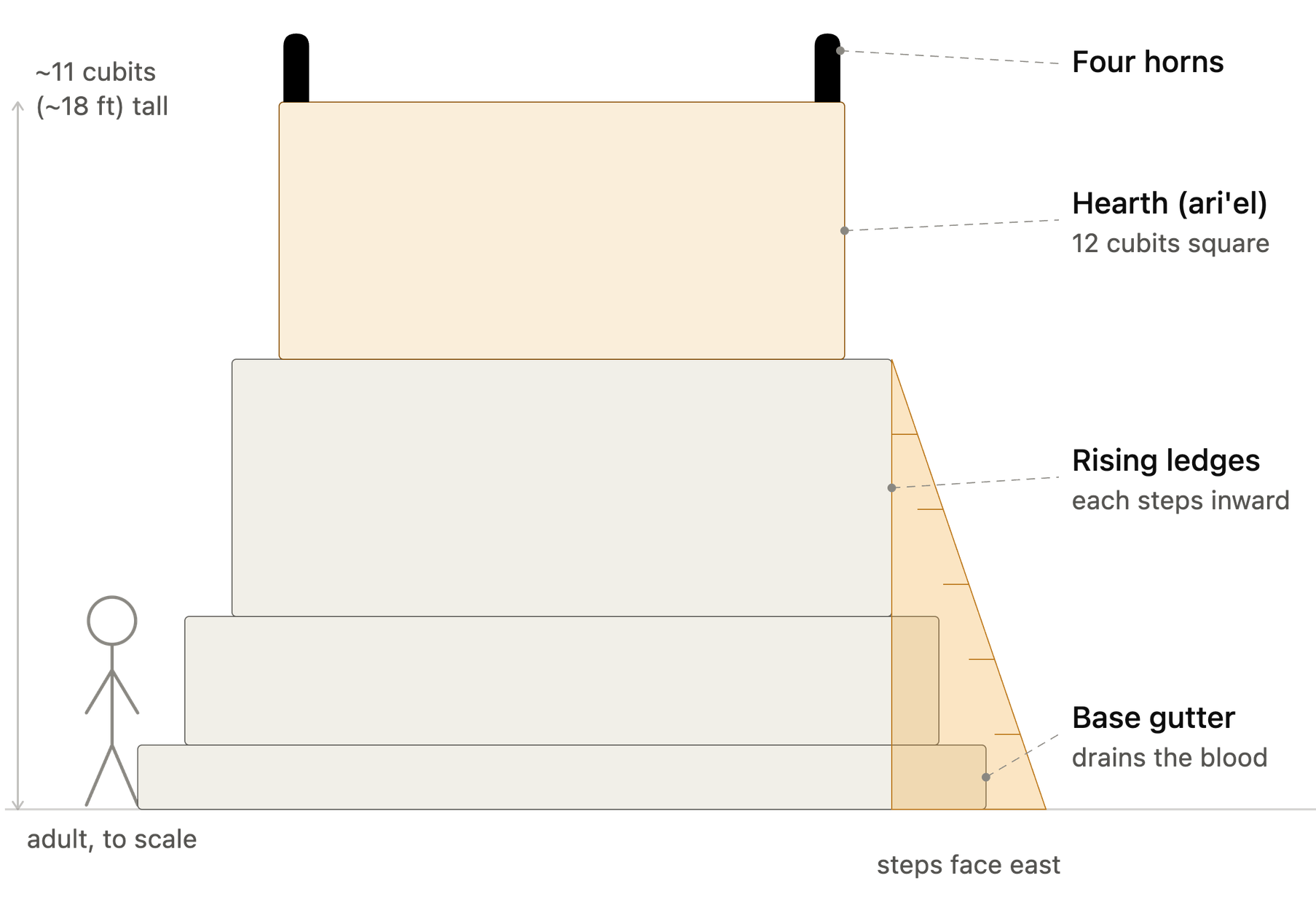
The measurements begin. "These are the measurements of the altar in long cubits, that cubit being a cubit and a handbreadth: Its gutter is a cubit deep and a cubit wide, with a rim of one span around the edge." The text pauses to define its unit before it builds. The "long cubit" is the standard cubit—roughly eighteen inches, the length from elbow to fingertip—plus an extra handbreadth of about three inches, giving a cubit of roughly twenty-one inches. The deliberate choice of the longer royal measure is a subtle marker. This is sacred architecture, set apart from ordinary construction, built on a grander scale than a common building.
The "gutter" at the base is a drainage channel, and its inclusion carries weight. An altar of sacrifice is a place of blood, and blood must be managed. The design accounts from the ground up for the reality that atonement is bloody, building the handling of that blood into the very foundation of the structure. The remedy for sin is not clean or abstract; it runs and must be drained.
The Ascending Tiers of the Altar (vv. 14-15a)
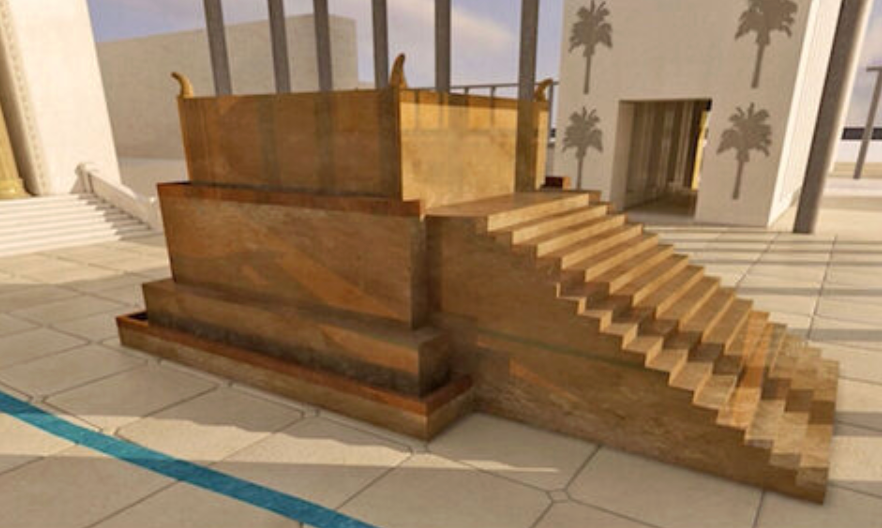
The description then climbs the altar in stages. "From the gutter on the ground up to the lower ledge, it is two cubits high and a cubit wide, and from the smaller ledge up to the larger ledge it is four cubits high and a cubit wide." The altar rises as a series of ascending platforms, each one narrower than the one beneath it, like a small stepped tower. This shape is not incidental, and it would have been instantly recognizable to Ezekiel's audience.
Deep Dive: The Tiered Altar and the Ziggurat Form (vv. 14-15)
Core Meaning: The altar is built as a stack of square platforms, each smaller than the one below, rising to a hearth at the top. This stepped-pyramid shape strongly resembles the ziggurat, the towering tiered temple-platform that dominated the skyline of Babylonian cities—including the very Babylon in which Ezekiel's audience was living.
Theological Impact: Many scholars read this resemblance as intentional and pointedly subversive, though the tiers can also be read more simply as functional, providing height and access for the officiating priest. If the ziggurat echo is deliberate, its force is striking. The ziggurat was designed as a stairway for a pagan god to descend to earth and for priests to climb toward the god—a human-built ladder into heaven, the same impulse that drove the Tower of Babel (Genesis 11). Ezekiel's altar borrows the recognizable shape but inverts its meaning entirely. This is not a structure that humans climb to reach up to God. It is the place where God, having already descended in glory of his own free will, provides the means for sinners to be reconciled to him. The direction of initiative is reversed. Not humanity ascending by its own effort, but God descending and then supplying the remedy.
Context: For exiles who walked past massive Babylonian ziggurats every day—monuments to the power and self-sufficiency of Babylon's gods—an altar shaped like a ziggurat would have been immediately legible. On the subversive reading, Ezekiel takes the most impressive religious symbol of the empire that conquered them and repurposes its very outline to declare that the true God is not reached by human climbing but approached through the blood atonement he himself ordains.
The Hearth and the Horns (vv. 15b-16)
The climb reaches its summit. "The altar hearth is four cubits high, and four horns project upward from the hearth." Two features at the top demand separate attention, and the Hebrew of this verse is unusually rich.
The hearth is named with a striking word. The NIV's "altar hearth" translates a Hebrew term that the verse actually spells in two forms in quick succession—first har'el, which reads as "mountain of God," and then ari'el, which can mean "hearth of God" or even "lion of God." The text deliberately juxtaposes the two spellings. The fiery summit of the altar is called, in effect, the mountain of God—the place where earth reaches its highest sacred point and where the fire of sacrifice burns. The same word ari'el later becomes a poetic name for Jerusalem itself (Isaiah 29:1), the city of God's altar-hearth. The altar, then, is a miniature holy mountain, an echo of Sinai's fire and smoke set at the center of the sanctuary. The wordplay is not decoration; it tells the worshiper what this structure is—a small Sinai, a meeting place of fire and God.
Then come the horns. "and four horns project upward from the hearth." In Israel's world the horn is a fixed symbol, and it too deserves its own treatment.
Deep Dive: The Four Horns of the Altar (v. 15)
Core Meaning: At each of the four upper corners of the altar, a projection called a "horn" rises up. In the Hebrew Bible the horn (qeren) is a settled symbol of strength and power, drawn from the horns of a bull or ram—the animal's most formidable weapon and the seat of its might.
Theological Impact: On the altar, the horns became the focal point of atonement. In the sacrificial system the priest smeared the blood of the sin offering on the horns of the altar (Leviticus 4). The symbol of strength thus became the exact spot where the power of atoning blood was applied. The horns also became a place of refuge. A person fleeing danger could seize the horns of the altar and claim sanctuary (1 Kings 1:50; 2:28), clinging to the strength of God's altar as a place of mercy. Power and mercy meet at the same four points.
Context: Archaeologists have recovered Israelite altars with exactly these corner horns, confirming that the biblical descriptions reflect real cultic architecture. In the surrounding cultures, horned altars and horn-crowned deities were widespread emblems of divine potency. Ezekiel's altar takes this shared vocabulary of power and channels it entirely toward the biblical purpose of blood atonement and refuge.
Modern Analogy: Consider how a courthouse holds two functions in one building. It is the seat of the law's full coercive power, and it is at the same time the place a wronged person goes seeking protection and redress. The horns of the altar carry that same double meaning. They are the emblem of raw strength and, simultaneously, the handhold a desperate person grabs for mercy.
The Squared Symmetry of the Altar (vv. 16-17)
The vision now squares off the whole structure. "The altar hearth is square, twelve cubits long and twelve cubits wide." Then the ledge below it: "The upper ledge also is square, fourteen cubits long and fourteen cubits wide... and the ledge all around it is a cubit wide." The perfect square is not a neutral engineering fact; in Israel's symbolic world it carries meaning. A shape equal on all four sides speaks of order, stability, and balance. It also ties directly to the number four already sounded in the "four horns" and now echoed in the four equal sides.
That number four is quietly theological. Four is the number of the created world in its full extent—the four winds, the four corners of the earth, the four cardinal directions. A squared altar, oriented to all four directions, presents itself as a structure addressed to the whole world, a fixed and ordered center at the heart of a restored creation. Where the old temple's holiness had leaked at its edges, this altar is balanced and sealed on every side, its symmetry declaring that the place of atonement stands stable, complete, and open to all directions of the earth.
The section closes by fixing the altar's orientation. "The steps of the altar face east." The eastward-facing approach means the officiating priest ascends toward the west—toward the sanctuary and the presence dwelling within it. Every movement at the altar is therefore oriented, quite literally, toward God. The worshiper climbs the miniature mountain with his face set toward the glory that has just come home.
Step back now and let the separate measurements resolve into a single object, because until you see the whole, the numbers stay abstract. Stack them up: a broad square base with its blood-gutter, then a tier of two cubits, then a tier of four, then the four-cubit hearth on top, each level stepping inward as it rises. Together they lift the hearth to roughly ten or eleven cubits above the ground—close to eighteen feet, the height of a two-story house. This is not a modest table a priest leans over. It is a towering, stepped structure that a man must climb, and beside it an ordinary person stands only shoulder-high to its lowest tier. The altar dominates the inner court the way a small mountain dominates a plain. And that is exactly the impression it is built to give. The place where sinners meet God through blood is not tucked away at eye level; it rears up over the worshiper, a constructed holy mountain at the center of the sanctuary, so that every approach to God is quite literally an ascent. The sheer size preaches before a single sacrifice is offered: to draw near to this God is to come to something far greater than yourself.
There is a quiet surprise buried in those steps, one an Israelite steeped in the law would catch immediately. The original altar law given at Sinai had forbidden steps: "And do not go up to my altar on steps, or your private parts may be exposed" (Exodus 20:26). The early altar was to be low and stepless, approached without the indignity of climbing. Yet Ezekiel's altar plainly has steps. This is not a contradiction but a development, and the reason lies in what the vision provides elsewhere. The old prohibition guarded against the exposure of a priest's nakedness during the ascent—a matter of preserving the dignity and modesty that holiness demands. Ezekiel's temple removes the danger at its root by clothing the priests properly: they are to wear linen undergarments "and must not wear anything that makes them perspire" (Ezekiel 44:18), covering exactly what the Sinai law was concerned to protect. Once the priest is fully and fittingly clothed, the reason for the ban falls away, and the altar can rise to the towering height its grandeur calls for. The law's underlying concern—that nothing shameful be exposed before the holy God—is not discarded but honored in a new way, and the altar is freed to become the mountain it was meant to be.
The Consecration and Atonement of the Altar (vv. 18-27)
An Altar That Must First Be Cleansed (v. 18)
The voice from the sanctuary speaks again, giving Ezekiel the ritual instructions. "Son of man, this is what the Sovereign LORD says: These will be the regulations for sacrificing burnt offerings and splashing blood against the altar when it is built." A genuinely strange theological reality surfaces here, and it should be allowed to feel strange before it is resolved. The altar is the instrument of purification. It is the place where everything else is made clean, where sin is dealt with and defilement removed. And yet this very instrument must itself be purified before it can function. The tool of cleansing needs cleansing first. The thing that decontaminates must first be decontaminated.
Why should that be? The answer lies in a distinction at the heart of Israel's worship—the difference between holiness that is inherent and holiness that must be conferred. Only God is holy in himself. Everything else becomes holy only by being set apart and consecrated to him. The altar is a manufactured object, quarried and shaped by human hands in a fallen world, and so it enters existence as common, not holy. It has no holiness of its own to give. Before it can serve as the channel of atonement, it must first be moved across the line from common to sacred by a rite of consecration. An unconsecrated altar could no more cleanse a worshiper than an unwashed surgeon's hands could heal a wound. The means of purification must themselves be made pure, or the whole system fails at its source.
Two things in this opening verse need naming before the ritual begins, because the rest of the passage assumes them. First, the sacrifices are of different kinds. The verse mentions "burnt offerings" and "splashing blood," and in a moment "sin offerings" and "fellowship offerings" will follow. These are not interchangeable words for "sacrifice." Each is a distinct rite with a distinct meaning, and the order in which they appear across the seven days is the hidden argument of the whole passage. Watch the sequence as it unfolds; it moves somewhere on purpose. Second, notice the phrase "splashing blood against the altar." Blood was handled in two distinct ways in this chapter, and the difference tracked two distinct jobs. It could be daubed—placed carefully by hand, in small amounts, onto specific points like the horns and corners, as in the next verse. This was the targeted gesture of the sin offering: precise decontamination, cleansing the object at the very points that stood for the whole. Or it could be dashed—thrown from a basin against the sides of the altar in quantity, drenching it broadly, as named here. This wider gesture belonged to the burnt and fellowship offerings, the sacrifices of total dedication and restored communion: not spot-cleaning but the whole life poured out and presented to God. Daubing purges; dashing dedicates and offers. The chapter uses both because it does both.
The Priestly Line and the First Sin Offering (vv. 19-21)
God specifies who performs the ritual. "You are to give a young bull as a sin offering to the Levitical priests of the family of Zadok, who come near to minister before me, declares the Sovereign LORD." The first sacrifice named is a "sin offering"—in Hebrew the chatat, whose very name comes from the word for sin because its whole purpose is to remove it. The sin offering is the purification sacrifice, the rite that deals with defilement by applying blood to the contaminated object and so scrubbing it clean. It addresses the negative: it takes away what should not be there. That the consecration begins here is telling. Before anything can be dedicated or enjoyed, the pollution must first be dealt with. And the naming of Zadok's line is not a passing detail.
Deep Dive: The Zadokite Priesthood (v. 19)
Core Meaning: Zadok was the priest who stayed loyal to David during Absalom's rebellion and later backed Solomon's rightful succession over the usurper Adonijah (1 Kings 1). As a reward, his descendants held the high priesthood in Jerusalem for centuries. Ezekiel's vision restricts altar service specifically to this Zadokite line.
Theological Impact: In chapter 44 Ezekiel gives the reason. When the rest of the Levites drifted into idolatry, the sons of Zadok "kept charge of my sanctuary" and did not defile themselves (Ezekiel 44:15). Their reward is nearness—they alone "come near to minister." This encodes a core principle of the whole vision: access to the holy God is tied to faithfulness. Those who guarded holiness during the years of apostasy are entrusted with holiness in the era of restoration. The privilege of nearness follows a track record of fidelity.
Context: The exile had thrown Israel's entire religious leadership into doubt. The priesthood that had presided over the defiled temple shared in its corruption. By singling out the Zadokites, Ezekiel supplies a purified, trustworthy priestly core for the restored sanctuary—a line whose past loyalty qualifies it to handle the returned presence without repeating the old defilements.
The blood ritual follows in precise detail. "You are to take some of its blood and put it on the four horns of the altar and on the four corners of the upper ledge and all around the rim, and so purify the altar and make atonement for it." The blood is daubed—placed carefully by hand—on the exact points identified earlier: the horns, the corners, the rim. The strength-points of the altar are made the cleansing-points. But the whole action presupposes something the modern reader almost never has explained, and without it the chapter reads as inexplicable and even primitive. Why blood? Why should a smear of blood on a stone corner make anything clean?
Deep Dive: Why Blood? The Life in the Blood (v. 20)
Core Meaning: The entire sacrificial system rests on a single principle, stated plainly in the Law: "the life of a creature is in the blood, and I have given it to you to make atonement for yourselves on the altar; it is the blood that makes atonement for one's life" (Leviticus 17:11). Blood, in Israel's understanding, is not merely a fluid. It is life itself made visible—the physical carrier of the life that God gives and God owns. To pour out blood is to pour out a life.
Theological Impact: This is the hidden logic beneath every sprinkling and daubing in the chapter. Sin's ultimate wage is death; defilement is the contamination of death spreading through God's good creation. What can counter death? Only life. Blood cleanses because blood is life, and life is the one thing powerful enough to answer and reverse the death-power of sin. When blood is applied to the altar, a life is being offered in the place of the life that sin had forfeited—a life given so that the sinner's life need not be. It is substitution rendered in the most concrete terms imaginable: life for life. The blood does not work as a magic fluid; it works as a life laid down. This is why the sacrificial animal had to die, and why its death was never incidental to the ritual but the very heart of it.
Context: This principle set Israel sharply apart from the surrounding nations, and it also explains a law that otherwise seems arbitrary: Israel was strictly forbidden to eat blood (Leviticus 17:12–14). The reason was not squeamishness. Because blood is life, and life belongs to God alone, blood could never be treated as ordinary food. It was reserved entirely for the altar, for the sacred work of atonement. Where the surrounding cultures sometimes consumed blood in their rites, Israel returned it wholly to God as the life it represented. Every drop daubed on Ezekiel's altar is therefore a life surrendered to God, a death accepted so that the worshiper might live.
Modern Analogy: Consider the legal concept of a ransom—a life or a sum accepted in place of a life that is otherwise owed. In a hostage exchange, one thing of matching value is surrendered so the captive can go free; the payment is not symbolic decoration but the actual price that secures release. The blood on the altar functions as exactly this kind of price. A life is rendered up so that another life, rightly forfeit, is released. The exchange is real, and it costs a death.
Deep Dive: Making Atonement (Kaphar) for the Altar (v. 20)
Core Meaning: The Hebrew verb translated "make atonement" is kaphar. Its root sense clusters around two images: "to cover" (as one covers a debt or a stain) and "to wipe away" or "purge" (as one scrubs a contaminated surface clean). In the sacrificial system it means to remove the pollution of sin so that fellowship with the holy God becomes possible.
Theological Impact: Applying kaphar to the altar itself reveals how Ezekiel understands sin. It is not merely a broken rule to be forgiven but a defiling substance that clings to objects and spaces and must be physically purged with blood. The altar accumulates a kind of impurity simply by existing in a fallen world and by absorbing the sins it processes. It must therefore be periodically decontaminated. Blood is the cleansing agent—as the previous Deep Dive showed—because blood is life, and life is what counters the death-power of sin and uncleanness.
Context: This same logic governs the great Day of Atonement in Leviticus 16, where blood cleanses not only the people but the sanctuary and its furniture, purging the accumulated defilement of an entire year. Ezekiel's altar consecration runs on the identical principle. Before the holy God can be served at this altar, the altar must be scrubbed clean by blood.
Modern Analogy: Think of a hospital operating room that has just been used for contaminated surgery. Before the next patient can be brought in, the room itself must be sterilized—the very space where healing happens has to be decontaminated first, or it will transmit disease instead of curing it. Kaphar on the altar works the same way. The site of cleansing is itself scrubbed clean by blood before it can safely cleanse anyone, and it is re-scrubbed as the defilement it absorbs accumulates over time.
With the blood applied, the body of the animal is disposed of in a specific way. "You are to take the bull for the sin offering and burn it in the designated part of the temple area outside the sanctuary." This instruction is not a note about tidiness, and it points to a distinction in the Law that most readers have never had explained. Israel actually had two classes of sin offering, handled in opposite ways. In the ordinary sin offering, the priests ate the meat—their consuming of it was part of how the guilt was carried away (Leviticus 6:26). But when the blood was brought inside, into the sanctuary itself, to cleanse the holy things, the rule reversed: that animal's body could not be eaten by anyone and had to be burned outside (Leviticus 6:30; 4:11–12). Ezekiel's altar follows this higher pattern, because its blood is applied to the sanctuary's own central furniture.
So this carcass is neither eaten nor burned on the altar—it is expelled and destroyed beyond the sacred space, and the reason is the same for both. Having absorbed the impurity it was slaughtered to remove, the body now carries the very defilement it dealt with. It cannot be eaten, because it now bears sin; it cannot be burned on the holy altar, for the same reason. It must be carried outside and consumed there. The place of burning is the place of banishment. What bears sin is driven out. This double expulsion—not eaten, not on the altar, but out—will prove to be one of the most significant patterns in the whole chapter when we reach the Christocentric resolution.
Seven Days of Consecration (vv. 22-26)
The ritual then extends across a full week, and it helps to see the daily shape of it clearly, because the text distributes the details across several verses. Each day has two movements: first a sin offering to purge, then a burnt offering to dedicate. And there is one deliberate change in the pattern. "On the second day you are to offer a male goat without defect for a sin offering, and the altar is to be purified as it was purified with the bull."
Notice the animal has changed. The first day's sin offering was a young bull (v. 19); from the second day on, it becomes a goat. This is not random, and the shift carries meaning.
Deep Dive: Why the Bull Becomes a Goat (v. 22)
Core Meaning: Israel's law graded its sacrifices by value, and the value of a sin offering scaled to the weight and scope of what was being atoned for. The bull was the costliest, highest sin offering in the entire system, reserved for the gravest occasions—the sin of the high priest or of the whole congregation (Leviticus 4:3, 13–14). The male goat ranked a step below it, the standard purification animal for lesser cases (Leviticus 4:22–23). More costly animal, weightier atonement.
Theological Impact: Apply that graded logic to the altar's consecration and the change makes sense. The first act of cleansing is the greatest one: a brand-new altar, fresh from human hands and utterly common, being purged and carried across the line from ordinary to holy for the very first time. That inaugural, once-only crossing calls for the maximum offering—the bull. Once that foundational cleansing is accomplished on day one, the following six days complete and confirm a consecration already begun. The decisive break has been made; now the week is being filled out to fullness. That ongoing daily purification is fittingly served by the goat, the standard cleansing animal—sufficient for the continuing work without repeating the maximal offering of the founding day. The pattern is simple once seen: the greatest animal for the founding act, the standard animal for the completing days.
Context: There is a fitting resonance in the choice of the goat, too. The goat is the characteristic purification animal of Israel's worship—it is the animal of the Day of Atonement (Leviticus 16), the one most closely tied to removing the people's impurity. Its dominance across the six days keeps the emphasis exactly where this whole consecration lives: on scrubbing the altar clean, day after day, until the full week has done its complete work.
A second kind of offering now enters. "When you have finished purifying it, you are to offer a young bull and a ram from the flock, both without defect. You are to offer them before the LORD, and the priests are to sprinkle salt on them and sacrifice them as a burnt offering to the LORD." Here is the "burnt offering," in Hebrew the olah, from a root meaning "to go up" or "to ascend." Its defining feature is total consumption: unlike other sacrifices, the burnt offering is burned whole on the altar, nothing kept back, nothing eaten, the entire animal turned to smoke that rises to God. If the sin offering deals with the negative—removing defilement—the burnt offering expresses the positive: complete surrender, the whole self given up and ascending to God without remainder. The order matters. Only once the altar has been purged by the sin offering can it bear the burnt offering that ascends from it. Cleansing comes first; total dedication follows.
Notice, too, that the burnt offering here pairs two animals—a young bull and a ram. The ram deserves a word, because it is not chosen at random. In Israel's worship the ram is repeatedly the animal of ordination and consecration: it was the ram whose blood set apart Aaron and his sons for priestly service, called literally "the ram of ordination" (Exodus 29:22–26). Its presence in this burnt offering quietly reinforces what the whole week is doing—consecrating, setting apart, ordaining this altar for holy service. The bull brings weight and value; the ram brings the specific note of consecration.
The steady requirement of animals "without defect" runs through all of it. What is offered to a perfect and holy God must itself be whole and unblemished, the best of the flock. The Hebrew word is tamim, meaning complete, sound, without flaw. A damaged or leftover animal would insult the perfection of the One being approached, implying that the second-rate is good enough for God. Perfection in the worshiper's gift answers the perfection of the God who receives it.
The whole cycle is then set for the full week. "For seven days you are to provide a male goat daily for a sin offering; you are also to provide a young bull and a ram from the flock, both without defect." The daily rhythm is now plain: goat to purge, bull and ram to dedicate, every day for seven days. And the seven-day span is not an arbitrary stretch of time. It reaches back to the foundational consecration liturgy of Israel and repeats it deliberately.
Deep Dive: The Seven-Day Consecration (vv. 25-26)
Core Meaning: The altar is not usable after a single rite. It must pass through seven full days of daily offerings before it is "dedicated." This seven-day ordination directly echoes the consecration of Aaron and the original altar at Mount Sinai, described in Exodus 29 and carried out in Leviticus 8, where the priests and the altar were set apart over exactly seven days.
Theological Impact: By repeating the Sinai pattern, Ezekiel signals that the restored worship is not a fresh invention but the re-founding of Israel's original covenant worship on cleansed ground. The number seven throughout Scripture marks completeness and wholeness, rooted in the seven days of creation. A seven-day consecration therefore says that the altar is being brought to a complete, finished, fully sufficient state of holiness. Nothing is partial, nothing rushed. The altar is not fit for its work until the full cycle has run its course.
Context: The link to Exodus 29 and Leviticus 8 places Ezekiel's vision in continuity with Moses. What Moses inaugurated at Sinai, and what was defiled and lost in Jerusalem, is here re-established in the visionary temple. The exiles are being told that the ancient, God-given pattern of consecration has not been abandoned; it is being restored intact, on a foundation purified so thoroughly that it need never be defiled again.
Deep Dive: Salt on the Offering (v. 24)
Core Meaning: The priests are told to sprinkle salt on the offerings before presenting them. Salt was a preservative and a purifier, resistant to decay, and in the ancient world it served as a standard seal of a binding agreement.
Theological Impact: Scripture speaks of a "covenant of salt" (Numbers 18:19; 2 Chronicles 13:5)—a bond as permanent and incorruptible as salt itself. Sprinkling salt on the offering marks the sacrifice as part of an enduring, unbreakable covenant relationship. It signals permanence. This restored worship is not provisional or temporary but sealed to last, matching the "forever" of God's dwelling declared back in vv. 7 and 9.
Context: In ancient Near Eastern diplomacy, sharing salt could ratify a treaty, and salt's resistance to rot made it a natural emblem of a relationship that would not decay. By requiring salt on every offering, the vision embeds covenant permanence into the very act of sacrifice, reinforcing the theme that the presence which has returned has returned to stay.
The week's work is then summarized in a single verse that quietly stacks three verbs on top of one another. "For seven days they are to make atonement for the altar and cleanse it; thus they will consecrate it." These are not three ways of saying the same thing; they name two distinct movements. To "make atonement" and "cleanse" (the Hebrew taher, to purify) is the emptying work—the removal of defilement, the scrubbing away of what pollutes. To "consecrate" (the Hebrew qadash, to make holy) is the filling work—the positive setting-apart of the altar for God's exclusive use. The order is fixed and cannot be reversed. First the object is emptied of uncleanness; only then can it be filled with holiness. You cannot dedicate a dirty vessel to sacred use; you must first wash it, and then set it apart. Cleansing clears the ground, and consecration builds on it. The seven days accomplish both, in that order, so that by the end the altar is not merely clean but holy—purged of the common and claimed wholly for God.
The Threshold of Acceptance (v. 27)
The section, and with it the whole chapter, reaches its goal in a promise. "At the end of these days, from the eighth day on, the priests are to present your burnt offerings and fellowship offerings on the altar. Then I will accept you, declares the Sovereign LORD." Everything has been building to this verse, and it must be read slowly, because three distinct things arrive together: a new day, a new set of offerings, and a word of acceptance.
Deep Dive: The Eighth Day (v. 27)
Core Meaning: After the seven days of consecration are complete, the "eighth day" marks the first day of normal, ongoing worship. In Israel's calendar the eighth day is a recurring marker of a new beginning that follows a completed cycle—circumcision on the eighth day (Genesis 17:12), the eighth-day inauguration of Aaron's active priesthood after his seven-day ordination (Leviticus 9:1), and the climactic eighth-day assembly of the Feast of Tabernacles (Leviticus 23:36).
Theological Impact: The eighth day is the day after fullness, the first day of a new order. Seven completes the old cycle of creation and consecration; eight opens something new on the far side of it. When the altar's service begins "from the eighth day on," the vision signals that a new era of worship has dawned—not a repair of the old defiled system but a fresh beginning on cleansed ground. The worshiper steps into a genuinely new day, the first morning of a restored fellowship with God.
Context: This eighth-day pattern would later feed the early church's association of the eighth day—the day after the Sabbath, the day of resurrection—with new creation. Within Ezekiel's own frame, it marks the transition from the once-for-all founding rites to the perpetual, living worship of a people whose God has come home to stay.
Now watch what the offerings do on that eighth day, because the whole ritual has been quietly moving toward this. For seven days the purging sin offering led each day, cleansing and removing defilement. On the eighth day the offerings named are different: "burnt offerings and fellowship offerings." The sequence is the entire message. First the sin offering emptied the altar of pollution. Then the burnt offering gave the whole self, ascending to God in total dedication. And now, at the last, comes the offering that has not yet appeared in the chapter at all—the fellowship offering—and it is the note the chapter chooses to end on.
Deep Dive: The Three Offerings and Their Progression (v. 27)
Core Meaning: Israel's worship used several distinct sacrifices, and this chapter names three of them in a deliberate order. The sin offering (chatat) purges defilement—it removes what is wrong. The burnt offering (olah, "ascending") is consumed whole, the entire animal turned to smoke rising to God—it expresses total dedication, holding nothing back. The fellowship offering (shelamim, from shalom, "peace") is unique: it is the one sacrifice the worshiper shares in eating, a meal in which portions go to God and to the priests, and the rest is eaten by the offerer and his family in God's presence—it celebrates restored relationship, communion, peace with God enjoyed at a shared table.
Theological Impact: These three cannot be reordered without destroying the logic. You cannot enjoy fellowship with God while defilement still stands between you, so the sin offering must come first and clear the barrier. You cannot rightly feast at God's table while withholding yourself from him, so the burnt offering follows and gives the whole self. Only then, on cleansed ground and in full surrender, does the fellowship offering become possible—the shared meal that says the estrangement is over. The movement is purge, then dedicate, then commune. It is the anatomy of reconciliation itself: sin removed, self given, relationship restored.
Context: This is why ending on the fellowship offering carries such weight in Ezekiel. The book opened with a God who withdrew from a defiled house, breaking off communion with his people. It has now traced the long road back: the glory returns, the terms of holiness are set, the altar is measured and purged and consecrated, and the offerings climb from cleansing to dedication to—finally—a shared meal. The fellowship offering on the eighth-day altar is the ritual picture of the whole book's hope. God and his people are eating together again. The exile of the presence ends not merely in God's return, but in a table.
And so the chapter's final word lands with its full force. "Then I will accept you." This single phrase is the destination toward which everything has strained, and it resolves in three distinct effects that a quick reading would blur together.
First, consider who is accepted and how. The acceptance is corporate and mediated. God does not simply pronounce a warm feeling toward individuals; he accepts the people through the offerings the priests present on their behalf. Acceptance comes through an appointed mediator and an appointed sacrifice, not through direct and unmediated approach. The worshiper is received, but received by way of the altar and the priest.
Second, consider the basis. The acceptance rests on everything that came before it in the chapter—the cleansed altar, the seven days of blood, the offerings without defect, the whole progression from purging to dedication to fellowship. "Then I will accept you" is the last link in a chain, and the word "then" is doing real work. Acceptance is grounded in completed atonement, not in bare divine sentiment. God receives the people because the price of approach has been paid and the place of approach has been purified. Take away the altar and its blood, and the "then" collapses.
Third, consider what the word reverses. The Hebrew verb here (ratsah) is the technical language of favorable cultic reception—the term for an offering that God looks upon with pleasure and receives. Its opposite is the divine rejection of a defiled offering, the refusal that Ezekiel and Leviticus both describe when worship is corrupt. This is the exact word Israel most needed to hear. The God who had rejected them, whose glory had recoiled from a defiled temple and withdrawn in judgment, now looks upon his people and their offerings with favor once more. And the acceptance is not merely a legal clearance; it is the welcome that makes the fellowship meal possible. To be "accepted" is to be received back to the table. The estrangement that began with the departure of the glory ends here, in a single verb of favor—the presence that left in rejection now says, over a shared altar, I receive you again.
The Hermeneutical Bridge: The Meaning "Now"
Timeless Theological Principles
Several enduring truths rise out of Ezekiel 43, valid for God's people in every age:
- The presence of God is the true treasure and the true crisis: What made the temple matter was never its architecture but the kavod, the weighty presence of God dwelling there. The whole chapter turns on the return of that presence. This teaches that the deepest human need is not comfort, security, or restored fortunes, but God himself dwelling with his people.
- Holiness and the presence of God are inseparable: God will dwell only where defilement has been put away (vv. 7–9). His nearness is never casual; it makes real moral and spiritual demands on those who would host it. A holy God requires a holy dwelling, and he will not share his space with idolatry or death.
- God acts for the sake of his own name: The defilement of vv. 7–8 is described as an assault on God's holy name—his public reputation before the watching nations. The glory returns not because Israel earned it back but because God will not leave his own name profaned. This teaches that grace rests on a surer foundation than human worthiness: God's own commitment to display the truth about who he is. He is faithful because he cannot deny himself.
- Honest shame can be the doorway to restoration: The perfect vision is meant first to produce shame (v. 10), exposing the gap between God's design and human failure. This teaches that facing our sin honestly is not the enemy of grace but often its instrument. God restores people who are willing to see what they have done.
- Atonement is life given for life: The elaborate consecration of the altar declares that the distance between a holy God and a defiled people is bridged only by blood—and blood, in Scripture's own logic, is life poured out (Leviticus 17:11). Because sin's wage is death, only a life surrendered can answer it. Access to God is always purchased by a substituting life that God himself provides, never presumed and never cheap.
- God takes the initiative in reconciliation: He returns of his own free will, provides the altar, specifies the offerings, and pronounces the acceptance. From first to last the movement runs from God toward his people, not from people upward toward God.
- The goal of atonement is communion, not merely pardon: The chapter's ritual does not end with sins removed; it ends with a shared meal, the fellowship offering on the eighth-day altar (v. 27). This teaches that God's aim in dealing with sin is never only to clear a debt but to restore a relationship—to bring his people back to the table. Reconciliation completes itself in fellowship.
Bridging the Contexts
Elements of Continuity (What Applies Directly):
- The presence of God as the goal of all worship: The exiles' longing for God to dwell among them is the same longing that animates every believer. Scripture presents God's indwelling presence as the consistent aim of redemption from Eden to the New Jerusalem, so this yearning carries straight across into the present. The believer today is called to the same posture the vision assumes—prizing God's nearness above every other restoration.
- The call to put away idolatry: The demand of vv. 7–9 to remove the "prostitution" and defilement is not locked in one century. Idolatry—giving to created things the trust and devotion owed to God alone—remains the perennial human failure. The passage calls for the same decisive separation from competing loves and false worship, because the character of the God who tolerates no rivals does not change.
- The posture of reverent humility: Ezekiel falls facedown before the glory (v. 3). This bodily collapse before holiness models the awe that remains the fitting human response to God's majesty. Since the God encountered is the same God, the reverence he evokes is the same. Worship that has lost all sense of awe has drifted from what this text assumes.
- The necessity of atonement for access: The principle that a defiled people cannot approach a holy God without a cleansing, substituting life applies directly, even though its outward form has changed. The need itself is permanent. Every believer still approaches God only through a provided atonement, never on the basis of unaided worthiness.
- Communion with God as a shared table: The fellowship offering that crowns the chapter (v. 27) points to a relationship enjoyed, not merely restored on paper. This carries directly into the Christian life, where reconciliation with God issues in real communion—supremely at the Lord's Table, where believers eat and drink in the presence of the God who has received them. The reasoning holds because the God who wanted to dwell among his people still wants to dwell with them, at a table, in fellowship.
- Shame as a servant of repentance: The call to feel honestly the gap between God's design and human failure (v. 10) still functions as a summons to genuine self-examination and turning. Because the holiness of God and the reality of human sin both endure, the honest shame that leads to repentance remains a healthy and necessary movement of the soul, not a relic of the past.
Elements of Discontinuity (What Doesn't Apply Directly):
- The physical altar and its blood rituals: The measured altar, the seven-day consecration, the bulls and goats and rams, the blood daubed on horns and corners—these belonged to the Levitical sacrificial system of ancient Israel under the covenant made at Sinai. In that world, animal sacrifice was the ordinary means of relating to the divine, and Israel's system channeled it toward the one true God. Ezekiel's own theological point was that atonement requires a life laid down, and that even the instrument of atonement must be purged. The rhetorical function of the detailed ritual was to assure devastated exiles that God had provided a concrete, workable means to survive his returned presence. These specific rites do not bind believers today, because the sacrificial system was the shadow cast ahead of a definitive sacrifice; once that reality arrived, the shadow's repeated blood offerings had completed their appointed purpose.
- The Zadokite priesthood: The restriction of altar service to the sons of Zadok (v. 19) addressed a specific crisis of leadership after the exile. Israel's priesthood had shared in the corruption that defiled the old temple, while the Zadokites, in Ezekiel's telling, had remained faithful during that apostasy. The author's assessment was that access to the holy must be entrusted to the proven faithful, and the rhetorical function was to supply the restored community with a trustworthy priestly core. This hereditary Levitical arrangement does not transfer directly, because it was bound to the specific genealogical and covenantal structures of Israel's cult—structures the New Testament sees replaced by a different order of priesthood after that of Melchizedek.
- The corpse-cult of the kings and the palace wall: The specific offense named in vv. 7–9—royal tombs and funeral rites crowding against the sanctuary, the palace threshold set beside the temple threshold—reflects the concrete geography of pre-exilic Jerusalem, where the kings of Judah were buried on the same ridge as the temple and the palace shared its acropolis. Ezekiel's assessment was that this literal proximity of death and monarchy to the holy had defiled God's name and provoked the destruction of 587 BC. Its rhetorical function was to explain the catastrophe as deserved judgment rather than divine defeat. This particular architectural scandal is tied to that specific historical setting and does not recur in the same form.
- The temple building itself: The physical sanctuary on the mountaintop, with its holiness first graded and then maximized across the whole precinct, was the covenantal meeting-place appropriate to the era of the Sinai covenant. Its function was to localize God's dwelling in one holy space on one holy mountain. This localized, architectural mode of God's presence belongs to that stage of Israel's history and is not reproduced as a building program for the people of God today.
Christocentric Climax:
The Text presents a house that stands finished but empty, waiting for an occupant, and a holy presence so consuming that an entire apparatus of walls, graded courts, blood, and consecrated priests must be raised simply to make it survivable for sinful people to live nearby. Here is the tension at its sharpest. God declares, "This is where I will live among the Israelites forever" (v. 7)—and yet the whole architecture of the vision is engineered to keep the profane at a safe distance from that very presence, lest it consume them. The glory returns, but it returns behind a perimeter now raised to maximum holiness on every side. The nearness is real and the barrier is real, and they stand together in a single breath. God has come home, and yet no ordinary Israelite may ascend that altar or step into that Most Holy Place. The presence dwells among them and remains, in the deepest sense, sealed away from them. Ezekiel's temple offers the paradox of a God who is at once intimately present and rigorously guarded—as close as feet resting on a footstool, as untouchable as fire on a mountain.
Christ provides the resolution of that exact tension by becoming, in his own person, every element the vision holds apart. John's Gospel makes the connection unmistakable: the Word "became flesh and made his dwelling among us. We have seen his glory" (John 1:14). The verb behind "made his dwelling" is eskēnōsen, "he tabernacled," pitching his tent among us—the Greek echo of the shakan dwelling of Ezekiel 43. The kavod that Ezekiel watched flood an empty building now floods a human body. The glory no longer returns to a house of stone through an eastern gate; it walks into the world in flesh, and the barrier that the whole temple existed to maintain is folded into the very presence it once guarded. In Christ the throne and the footstool, the dwelling glory and the access to it, are united in one person. The One who is himself the "most holy" now touches lepers and eats with sinners, and the holiness flows outward to cleanse rather than recoiling inward to consume. He is the true meeting of heaven and earth that every sacred mountain—Eden, Sinai, Zion—had only foreshadowed; when Nathanael is promised he will see heaven opened over the Son of Man, the cosmic mountain has become a person.
Consider the altar and its strange requirement. Ezekiel's altar had to be purged with blood before it could purge anyone; the instrument of cleansing needed cleansing first, because it was a made thing, common by origin, holy only by consecration. That requirement exposes the built-in limit of the whole system. An altar quarried in a fallen world carries its own defilement and can never rise above a managed, repeated remedy. Christ resolves this at the root. He is the altar that needs no consecration, because he has no defilement to purge and no common origin to overcome. He is himself the offering "without defect" that the vision demanded, brought not from the herd but from heaven, holy in himself rather than holy by rite. Where Ezekiel's altar had to be scrubbed clean before it could function, and re-scrubbed as defilement accumulated, Christ offers a single sacrifice that never needs repeating, because the one who offers it is inherently and unalterably pure.
And consider what that sacrifice actually costs, for the vision has taught us that blood is never merely a fluid but a life poured out—the life given in the place of the life that sin had forfeited. Every drop daubed on Ezekiel's altar declared the same terrible arithmetic: life for life, a death accepted so that another might live. The whole system was a thousand repetitions of that single sentence, spoken in the blood of bulls and goats that could never truly carry it, only point to it. Christ speaks the sentence once and means it fully. "This is my blood of the covenant, which is poured out for many" (Mark 14:24)—not the borrowed life of an animal but the very life of God the Son, surrendered as the true and final price. The life that Leviticus located in the blood, and that Ezekiel's altar handled with such fear, turns out to be, in the end, the life of the Lamb given for the world.
The detail that the sin offering's body was burned "outside the sanctuary" (v. 21) reaches its fulfillment with unnerving precision. In the logic traced in the commentary, this was the particular class of sin offering whose body could not be eaten at all but had to be expelled and destroyed, because it had absorbed the very sin it dealt with; the place of burning was the place of banishment, and what bore sin was driven out. The Letter to the Hebrews seizes on exactly this pattern, and on exactly this class of offering: "The high priest carries the blood of animals into the Most Holy Place as a sin offering, but the bodies are burned outside the camp. And so Jesus also suffered outside the city gate to make the people holy through his own blood" (Hebrews 13:11–12). The body consumed outside the holy space becomes the Son of God bearing sin outside the walls of Jerusalem. He is at once the priest who applies the blood and the sin offering carried out to be destroyed—the one driven beyond the gate because he has taken the defilement of his people onto himself. The banished carcass of the ritual finds its meaning in a crucifixion on a hill beyond the city, and the expulsion that once signified uncleanness becomes the very means by which the unclean are made holy.
Consider, too, the ziggurat-altar, the tiered structure that borrowed Babylon's stairway-to-heaven and turned its meaning inside out, declaring that God descends of his own will rather than being climbed toward by human effort. Christ is the final and personal inversion of Babel. Where humanity built a tower to ascend to the heavens and make a name for itself, God comes down in the Son, and the ladder between heaven and earth turns out to be not a structure but a person: "you will see heaven open, and the angels of God ascending and descending on the Son of Man" (John 1:51). The altar shaped like a stairway pointed beyond itself to the one who is himself the stairway—not a mountain that sinners scale by their works, but the God who descended the mountain to meet them at its foot.
Now consider the note on which the whole chapter chose to end, for it is the resolution the entire ritual was climbing toward. The offerings moved in a deliberate order—first the sin offering to purge, then the burnt offering to give the whole self, and finally, on the eighth day, the fellowship offering, the one sacrifice that ended in a shared meal, God and his people eating together in restored peace. The exile of the presence was not answered merely by God's return, but by a table. This is precisely where Christ carries the pattern to its end. On the night he was betrayed, he took bread and a cup and made himself the fellowship meal—"do this in remembrance of me" (Luke 22:19)—so that the reconciled might eat and drink in the presence of their God, not at arm's length behind a perimeter but at his own table, sharing his own life. The progression purge, dedicate, commune finds its living form in him: he is the sin offering that purges, the whole burnt offering wholly given, and the fellowship offering shared, all at once. And the table he opens is not the last. It runs forward to "the wedding supper of the Lamb" (Revelation 19:9), the feast at the end of all things where the estrangement that began in Ezekiel's chapter 10 is not merely repaired but crowned in joy. What the fellowship offering on the eighth-day altar could only sketch—God and his people at one table—Christ makes real and everlasting.
And consider the deepest resolution of all. Ezekiel's whole terror was that the glory, having returned, might one day depart again, as it had departed in chapter 10—that fresh defilement might once more drive God from his house. The maximized holiness of the entire mountain (v. 12) was the architectural attempt to make that departure impossible, to seal every edge against encroachment. Christ makes it not merely improbable but ontologically impossible—that is, impossible by the very nature of what has happened, not just unlikely. In him God does not simply occupy a building he might later vacate; he unites himself to humanity in a bond that death itself could not sever and that resurrection has made permanent. The presence that Ezekiel saw fill a house now fills a people by the Spirit: "you yourselves are God's temple" (1 Corinthians 3:16). The glory has moved from stone to flesh to the living community of the redeemed, and it will never withdraw. The final vision is of a city where "the dwelling of God is with mankind, and he will dwell with them" (Revelation 21:3)—a city, John is careful to note, with no temple in it at all, "because the Lord God Almighty and the Lamb are its temple" (Revelation 21:22). Ezekiel's empty, waiting house finds its end not in a grander building of stone but in the unveiled face of God and of the Lamb, where the barrier is gone forever and the nearness is complete.
Key Verses and Phrases
Ezekiel 43:2
"And I saw the glory of the God of Israel coming from the east. His voice was like the roar of rushing waters, and the land was radiant with his glory."
Significance: This is the theological summit of the entire book. The glory that had abandoned the temple in judgment (chapters 8–11) now returns, reversing the central catastrophe of the exile with exact symmetry, entering by the very gate through which it left. It declares that Israel's God was never defeated by Babylon and never permanently absent; his withdrawal was sovereign discipline, and his return is sovereign grace. Every promise in the final vision—the closed gate, the ordered priesthood, the river of life—rests on this single moment of homecoming.
Ezekiel 43:7
"Son of man, this is the place of my throne and the place for the soles of my feet. This is where I will live among the Israelites forever."
Significance: God's own declaration of the vision's purpose. It fuses sovereignty (the throne) with intimacy (the soles of his feet) and stakes everything on the word "forever," using the verb shakan that speaks of permanent settled dwelling rather than a passing visit. The same verse also grounds the whole restoration in God's concern for his defiled name, revealing that his commitment to dwell is anchored in his own character. This is the promise the exiles most needed to hear, and it becomes the thread that runs forward through all of Scripture to the eternal dwelling of God with humanity in Revelation 21.
Ezekiel 43:10
"Son of man, describe the temple to the people of Israel, that they may be ashamed of their sins. Let them consider its perfection."
Significance: A defining statement about how God restores a broken people. The perfect vision—a heavenly pattern measured to the cubit—is meant first to produce honest shame, exposing the gap between God's flawless design and Israel's corrupted reality. Like a covenant document deposited as a witness, its very exactness leaves no room for self-deception. It reveals that repentance, not flattery, is the doorway through which a devastated people re-enter the presence of God, and that grace and honest self-examination work together rather than against each other.
Ezekiel 43:27
"At the end of these days, from the eighth day on, the priests are to present your burnt offerings and fellowship offerings on the altar. Then I will accept you, declares the Sovereign LORD."
Significance: The destination toward which the whole chapter strains. The offerings climb in a deliberate order—purge, dedicate, and finally commune—so that the chapter ends not merely with sin removed but with a fellowship meal, God and his people at one table. The entire movement then resolves in a single verb of favor, ratsah, the technical word for an offering God receives with pleasure and the precise reversal of the rejection that drove the glory away. It shows that the whole apparatus of measurement and sacrifice exists to reach restored communion, and it anticipates the free acceptance believers receive in Christ, secured not by a week of blood but by one perfect sacrifice and sealed at his own table.
Concluding Summary & Key Takeaways
Ezekiel 43 is the emotional and theological summit of the book, and its tone moves in a deliberate arc from overwhelming awe to solemn demand to patient, practical provision. It opens with a flood of glory and a sound like rushing waters as the presence that once abandoned Jerusalem returns through the same eastern gate by which it departed. It closes with the quiet, weighty promise, "I will accept you," spoken over a shared table. Between these two poles the chapter insists that God's homecoming is real but never cheap. The returned presence demands a holiness so complete that the entire mountain becomes most holy, defilement is banished from every edge, and an altar is measured and consecrated in blood so that sinful people may survive their nearness to the living God. The prophetic trajectory runs from grief to restored fellowship, from the exile of the presence to its permanent, favorable dwelling—a hope that reaches far beyond Ezekiel's own century toward the day when God dwells with his people forever.
- The catastrophe reframed: The chapter reinterprets the destruction of 587 BC not as the defeat of Israel's God by Babylon's gods but as God's own sovereign judgment on a defiled sanctuary—"So I destroyed them in my anger" (v. 8). The offense is defined as the profaning of God's holy name, and this preserved the exiles' faith by explaining the disaster theologically rather than as evidence of divine weakness.
- Holiness built into the stones: The vision embodies the covenant demand for separation between the holy and the profane, correcting the specific pre-exilic failures—the corpse-cult and the palace crowding the temple—through an architecture of maximized holiness across the whole mountain, and sealing the restored relationship with the permanence of a covenant of salt.
- The centrality of presence: The whole chapter teaches that the return of the kavod, God dwelling among his people, is the true goal of restoration, a treasure deeper than the recovery of land, throne, or rebuilt walls.
- Atonement as life given for life: The consecration of the altar establishes that a holy God can be approached only through a substituting life poured out—for the life is in the blood—and that even the instrument of cleansing must first be cleansed. This built-in limitation, an altar that must be purged before it can purge, points beyond itself to a perfect and final atonement offered by one who needs no cleansing of his own.
- The goal is a shared table: The offerings ascend in a deliberate sequence—sin offering to purge, burnt offering to dedicate, fellowship offering to commune—so that the chapter ends not with a cleared debt but with God and his people eating together. Reconciliation completes itself in fellowship, a pattern fulfilled at the Lord's Table and consummated at the wedding supper of the Lamb.
- Continuity with Sinai: The seven-day consecration and the eighth-day inauguration deliberately repeat the ordination pattern of Exodus 29 and Leviticus 8, presenting the restored worship not as a novelty but as the re-founding of Israel's ancient covenant worship on purified ground.
- Practical application: Believers are called to prize God's presence above every other good, to put away rival loyalties, to approach God with reverent humility and honest self-examination, and to rest in the acceptance God freely provides—now secured not by a week of blood but by the once-for-all sacrifice of Christ, in whom Ezekiel's empty, waiting house finds its living and permanent fulfillment.