Daniel: Chapter 11
Historical and Literary Context
Original Setting and Audience: The vision is dated to the "first year of Darius the Mede" (c. 539 BC), placing the internal timeline at the chaotic dawn of the Persian Empire, immediately following the fall of Babylon. However, the prophetic scope addresses the Jewish faithful living centuries later, specifically under the transition from Persian dominance to the Hellenistic Crisis (c. 333–164 BC). The audience is the "wise" (maskilim) who are suffering under the "King of the North" (Antiochus IV). They need to understand that the chaos around them is not random; it is a playback of a pre-recorded script. The content is explicitly drawn from the "Book of Truth" (Ketav Emet) mentioned in Daniel 10:21—a heavenly scroll containing the fixed decrees of God. This framing assures the audience that earthly history is merely a recitation of what has already been written in heaven.
Authorial Purpose and Role: The narrator is not Daniel, but an Angelic Messenger (likely Gabriel) who has been engaged in cosmic warfare against the "Prince of Persia" (10:13, 20). His role is that of a Divine Historian revealing the contents of the heavenly scroll. The purpose is strictly theodicy and survival: to demonstrate that the rise and fall of pagan kings is part of a pre-ordained timetable ("determined" is a key keyword). By citing the "Book of Truth," the angel strips these empires of their perceived power, revealing them as actors merely following a script they did not write.
Literary Context: This chapter is the centerpiece of the final vision (Chapters 10–12). Chapter 10 provided the prologue (the spiritual warfare behind the scenes), ending with the promise to reveal "what is written in the Book of Truth." Chapter 11 is that revelation—a detailed, linear history of the Near East leading directly into the eschatological climax of Chapter 12.
Thematic Outline
A. The Persian Era and the Rise of Greece (vv. 1-4)
B. The Dynastic Wars: Kings of the South vs. Kings of the North (vv. 5-20)
C. The Rise of the "Contemptible Person" (Antiochus IV Epiphanes) (vv. 21-28)
D. The Desecration of the Covenant and the Persecution (vv. 29-35)
E. The Wilful King (vv. 36-39)
F. The End Time War (vv. 40-45)
Exegetical Commentary: The Meaning "Then"
The Transition of Empires (vv. 1-2)
The Angelic Support (v. 1)
"And in the first year of Darius the Mede, I took my stand to support and protect him."
- The Speaker: The "I" is the angelic being from Chapter 10. The verse serves as a bridge, looking back to the historical moment when Babylon fell.
- Theological Mechanism (Angelic Geopolitics): The angel states that he actively "stood to support" (le-mahaziq) the human king, Darius the Mede. This is a staggering claim: the stability of the Persian Empire was not due to Persian military might, but to angelic intervention.
- Narrative Motivation: Why support a pagan king? Because Darius was the instrument chosen to release the Jews (the Decree of Cyrus/Darius). The angel "propped up" the secular government solely to create the political stability necessary for the restoration of God's people.
- Analogy: This is similar to a structural engineer who shores up a crumbling building not because he likes the architecture, but because he needs it to stand long enough to safely extract the people trapped inside. The empire is sustained only for the sake of the remnant.
Deep Dive: The Book of Truth (v. 2)
Core Meaning: The Ketav Emet (Writing of Truth)—the heavenly record of God's sovereign decrees.
Theological Impact: This concept (rooted in Ancient Near Eastern "Tablets of Destiny") implies that history is not a series of random accidents, but the unfolding of a written text. When the angel speaks in Chapter 11, he is not predicting the future; he is quoting it. This provides absolute certainty to the suffering "wise" ones: the persecution has been written, but so has the deliverance.
Context: In 10:21, the angel says, "I will tell you what is written in the Book of Truth." Chapter 11 is the content of that book.
Modern Analogy: It is the difference between a sports commentator guessing who will win the game (prediction) and someone reading the score of a game that was played yesterday (record). To God, the future of the world is already history.
The Persian Succession (v. 2a)
"Now then, I tell you the truth: Three more kings will arise in Persia..."
- The Recitation: The phrase "Now then" marks the formal beginning of the reading from the Book of Truth.
- Atomic Decomposition (The Three Kings): The angel identifies a precise sequence. The "three more kings" following Cyrus (the current ruler in the vision's timeline) are:
- Cambyses II (530–522 BC): The conqueror of Egypt.
- Smerdis/Gaumata (522 BC): The usurper who reigned for only a few months.
- Darius I Hystaspes (522–486 BC): The great administrator who solidified the empire and began the wars with Greece.
- The Omission: The text skips the minor intricacies of their reigns to focus on the count. The number "three" sets the rhythm for the arrival of the critical "fourth."
The Catalyst of Conflict (v. 2b)
"...and then a fourth, who will be far richer than all the others. When he has gained power by his wealth, he will stir up everyone against the kingdom of Greece."
- Historical Identification: The "fourth king" is Xerxes I (Ahasuerus) (486–465 BC).
- The Mechanism (Wealth as Weapon): The text highlights his "wealth" as his primary characteristic. Xerxes inherited the stabilized empire of Darius I and used its vast treasury to fund the largest army the ancient world had ever seen (Herodotus estimates millions, though likely exaggerated, it was massive).
- The "Stirring Up" (Ya'ir): The phrase "stir up everyone" refers to his massive invasion of Greece in 480 BC (the battles of Thermopylae and Salamis).
- The Causal Link: This verse explains why the "Mighty King" (Alexander the Great) appears in verse 3. Xerxes' invasion failed, but it created a generational vendetta. He "stirred up" the hornet's nest of the West. The rise of Alexander 150 years later was the direct historical recoil of Xerxes' ambition. The Bible identifies Xerxes not just as a king, but as the architect of the nemesis that would eventually destroy his own empire.
The Rise of the Mighty King (v. 3)
A "mighty king" will appear who will "rule with great power and do as he pleases."
- The Identifier: The phrase "do as he pleases" (kirtzono) is a technical formula in Daniel for unchecked sovereignty (used of God in 4:35 and Cyrus in 8:4). This identifies Alexander the Great.
- Theological Nuance: Alexander is not described as "evil" here, but as a force of nature—a sheer manifestation of human power. His sovereignty is absolute.
- Narrative Motivation: Why does he appear now? He is the "reaction" to the "action" of Xerxes in verse 2. The text presents history as a pendulum of vengeance: Persian wealth stirs up Greek power, which then arrives to shatter the East.
The Diadochi Fragmentation (v. 4)
At the height of his power, his kingdom will be "broken up" and "parceled out toward the four winds of heaven."
- Symbolic Inventory (The Four Winds): This idiom represents the four cardinal directions, corresponding to the four heads of the leopard in Daniel 7. It signifies the global, chaotic scattering of the Greek dominion.
- The Negation: The text specifies it will "not go to his descendants" nor have the "power he exercised." This is a precise historical prediction of the end of the Argead dynasty. The phrase "uprooted" implies a violent extraction. The empire that replaces Alexander is derivative and diluted; the "Golden Age" of Greek unity dies with him, setting the stage for the centuries of warfare that will grind Israel between the gears of the North and South.
Deep Dive: The Broken Horn (v. 4)
Core Meaning: The immediate fragmentation of Alexander's empire upon his death.
Theological Impact: The text emphasizes the futility of human consolidation. The "Mighty King" builds a global empire, yet heaven decrees it will be "parceled out" and "not to his descendants." It deconstructs the myth of legacy.
Context: Alexander died in Babylon in 323 BC at age 32. His half-brother (Philip Arrhidaeus) and infant son (Alexander IV) were murdered, ending his bloodline. His generals (the Diadochi) fought the Wars of the Successors, eventually splitting the empire into four main blocs: Ptolemaic (Egypt), Seleucid (Syria/Mesopotamia), Lysimachian (Thrace), and Cassander (Macedonia).
Modern Analogy: This is similar to a massive corporate conglomerate whose charismatic CEO dies suddenly. Instead of passing the company to his children, the board of directors tears the company apart, carving out rival subsidiaries that immediately begin suing each other. The "brand" remains, but the unity is shattered.
The Dynastic Wars: Kings of the South vs. Kings of the North (vv. 5-20)
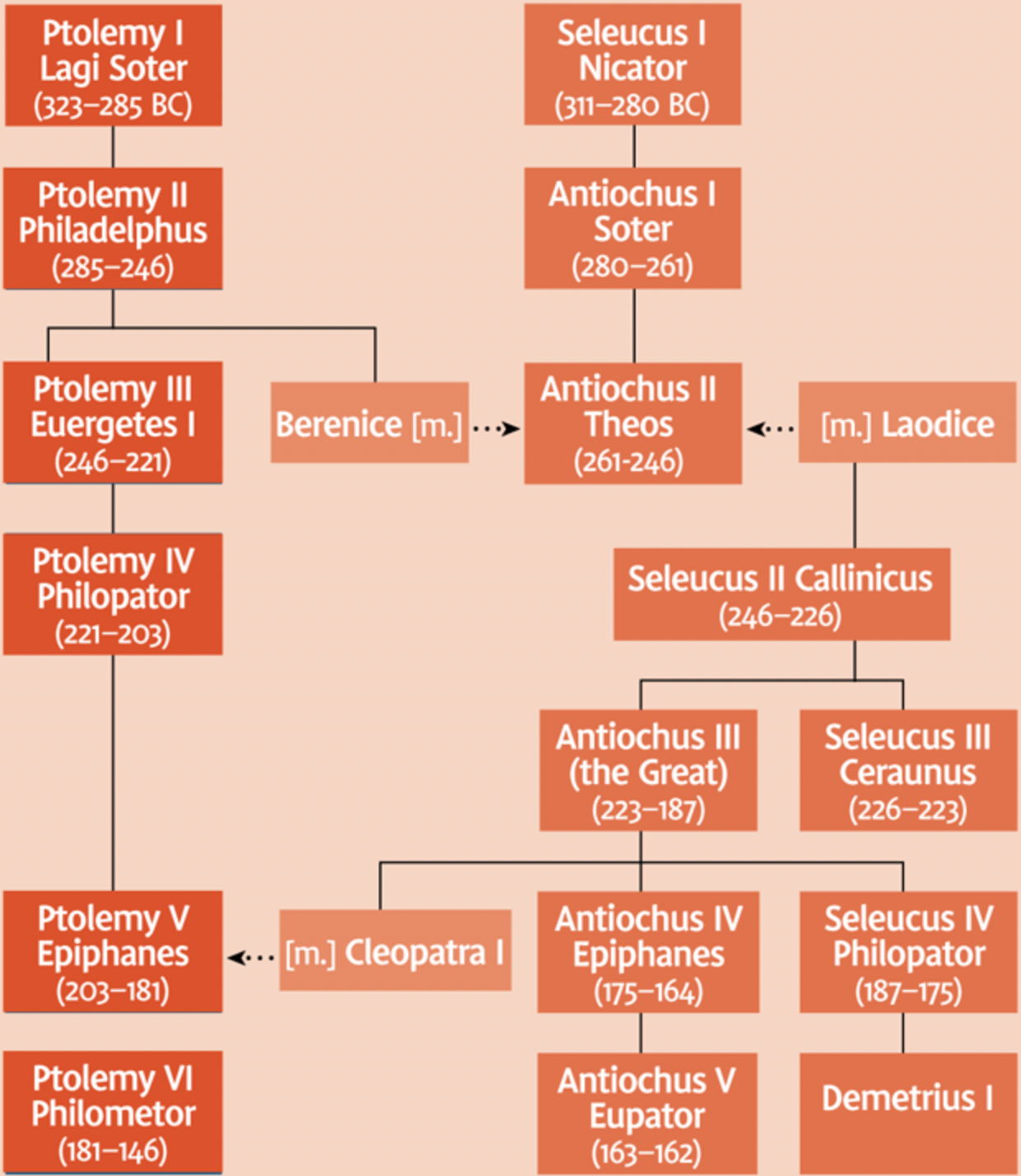
The Rise of the South (v. 5a)
"The King of the South will become strong..."
- The Player (King of the South): This title introduces the first pole of the conflict: the Ptolemaic Dynasty based in Egypt.
- Historical Identification: The specific king is Ptolemy I Soter (305–282 BC), one of Alexander's most capable generals who secured Egypt after the empire fractured.
- Geopolitical Definition: From this point on, "King of the South" always refers to the ruler of Egypt (the Ptolemies), and "King of the North" (introduced next) always refers to the ruler of Syria/Babylon (the Seleucids).
The Commander Who Surpasses (v. 5b)
"...but one of his commanders will become even stronger than he and will rule his own kingdom with great power."
- The Player (King of the North): This introduces the rival pole: the Seleucid Dynasty.
- Historical Twist: This describes Seleucus I Nicator (305–281 BC). After Alexander's death, Seleucus was forced to flee Babylon and serve as a general (satrap) under Ptolemy I in Egypt (hence, "one of his commanders").
- The Reversal: With Ptolemy's help, Seleucus returned to Babylon, reclaimed the eastern territories, and eventually established the massive Seleucid Empire.
- The Tension: The Seleucid Empire stretched from modern-day Turkey to India, dwarfing the Ptolemaic kingdom in landmass. This creates the structural tension of the chapter: a massive, sprawling Northern Empire (Syria) constantly seeking to absorb the wealthy, compact Southern Empire (Egypt).
Deep Dive: The Geopolitical Chessboard (The Syrian Wars)
Core Meaning: A 150-year conflict (301–164 BC) between the Ptolemies (South) and Seleucids (North) encompassing six major wars, known to historians as the "Syrian Wars."
The "Dynasty" Rule: The reader must understand that "King of the North" and "King of the South" are titles of office, not names of individuals. The Bible is describing a multi-generational feud. When one king dies, his son takes the title and continues the war.
- North: Seleucus I -> Antiochus I -> Antiochus II -> etc.
- South: Ptolemy I -> Ptolemy II -> Ptolemy III -> etc.
Theological Impact: Israel is the net. Geographically, the only way for the King of the North to attack the King of the South (or vice versa) is to march his army through Israel (Judea).
- The Result: Israel is never a combatant; it is the battlefield. The Holy Land is reduced to a buffer zone, trampled by whichever elephant is currently winning. This signifies the total loss of political agency for God's people; they are merely the grass that suffers when the beasts fight.
Modern Analogy: This is similar to Poland's history in the 20th century, trapped between Germany and Russia. Poland was the "land between," constantly partitioned, invaded, or "liberated" by one side to attack the other, regardless of what the Polish people wanted.
The Tragedy of the Diplomatic Marriage (v. 6)
The Alliance (v. 6a)
"After some years, they will become allies." The "daughter of the King of the South" will go to the "King of the North" to "make an alliance."
- Historical Specificity: This leaps to c. 250 BC (The Second Syrian War). Ptolemy II Philadelphus (South) gave his daughter, Berenice Syra, in marriage to Antiochus II Theos (North).
- The Cost: To marry Berenice, Antiochus II agreed to divorce his current wife, Laodice, and disinherit her children. This was a political transaction using human lives as currency to secure peace.
- Theological Mechanism: The text exposes the fragility of peace built on sin. The "alliance" (meysharim, literally "agreements/equity") was an attempt to bypass war through adultery (divorcing a rightful wife).
The Failure of Human Schemes (v. 6b)
The text predicts total collapse: she will "not retain her power," nor will he maintain his power. Instead, "she will be betrayed," together with "her royal escort," "her father," and "the one who supported her."
- The Narrative Mechanism: The text highlights the inherent instability of political marriages. Upon the death of Ptolemy II ("her father"), Antiochus II reconciled with his ex-wife Laodice.
- The Betrayal: Laodice, fearing for her position, allegedly poisoned Antiochus II and then murdered Berenice and her infant son. The word "betrayed" (tinnaten) captures the horror of the reversal: the very husband she was sent to marry (or the court she entered) turned on her.
The Laodicean War (vv. 7-9)
The Retaliation (v. 7)
"One from her family line will arise to take her place. He will attack the forces of the King of the North and enter his fortress;"
- Identity: This is Ptolemy III Euergetes, the brother of the murdered Berenice ("from her family line" literally means "a shoot from her roots").
- Motivation: This is a war of blood vengeance. The text notes he will "fight against them and be victorious." Ptolemy III launched a massive invasion into the heart of the Seleucid empire, reaching as far as Babylon. The "fortress" likely refers to Seleucia-in-Pieria, the port city of the Seleucid capital, Antioch.
The Plunder of the Gods (v. 8)
He will "seize their gods, their metal images, and their valuable articles of silver and gold and carry them off to Egypt."
- Covenantal Irony: The text focuses on the capture of "gods" (elohim). In the Ancient Near East, capturing an enemy's idols signified the defeat of their deities. Historically, Ptolemy III recovered Egyptian idols that the Persian king Cambyses had stolen centuries earlier.
- Theological Impact: The prophet mocks these "gods" by listing them alongside "metal images" and "valuable articles." They are not divine beings; they are just luggage. They cannot save themselves from being packed into crates and shipped to Egypt.
- The Result: For "some years he will leave the King of the North alone." This establishes a temporary peace born of dominance, not agreement.
The Failed Counter-Attack (v. 9)
The King of the North will "invade the realm of the King of the South but will retreat to his own country."
- Historical Note: Seleucus II Callinicus attempted to strike back at Egypt to restore his honor but was disastrously defeated and forced to flee.
- Theological Function: This verse emphasizes the futility of the cycle. Invasion leads to counter-invasion, which leads to retreat. The "King of the North" is humiliated, setting the stage for the rage of his sons in the next verses.
The Escalation of Conflict (vv. 10-14)
The Sons of the North (v. 10)
"His sons will prepare for war and assemble a great army, which will sweep on like an irresistible flood and carry the battle as far as his fortress."
- Atomic Decomposition (The "Flood"): The imagery of an "irresistible flood" (shataf) is a standard Ancient Near Eastern metaphor for an invading army (cf. Isaiah 8:7-8). It conveys the terrifying, overwhelming nature of the Seleucid advance that reclaimed the territories lost in the previous war.
- Historical Identification: This refers to the sons of Seleucus II: Seleucus III Ceraunus (who was assassinated quickly) and his brother, Antiochus III (the Great).
- Strategic Goal: The "fortress" here likely refers to the border fortress of Raphia (modern Rafah), the gateway to Egypt. The goal is no longer just defense, but total conquest.
The Battle of Raphia (vv. 11-12)
“Then the king of the South will march out in a rage and fight against the king of the North, who will raise a large army, but it will be defeated."
- Historical Context: This describes the Battle of Raphia (217 BC), one of the largest battles of the Hellenistic era. Ptolemy IV Philopator (South) mobilized an army, including native Egyptians trained as phalanxes (a first for the Ptolemies).
- The Outcome: Despite Antiochus III's larger force, Ptolemy IV won a decisive victory.
- Moral Failure (v. 12): The text notes that when the army is carried off, the King of the South will be "filled with pride" and will "slaughter many thousands," yet he will "not remain triumphant."
- Narrative Motivation: Why did he fail to capitalize on such a massive victory? Ptolemy IV was a hedonist. Instead of pressing his advantage to destroy the Seleucid threat permanently, he returned to a life of debauchery in Alexandria. The text judges his character: military success did not lead to security because it was undermined by moral lethargy.
The Persistent North (v. 13)
"For the king of the North will muster another army, larger than the first; and after several years, he will advance with a huge army fully equipped."
- The Timeline: This jumps forward about 15 years (c. 202 BC). Ptolemy IV died, leaving a child heir (Ptolemy V Epiphanes).
- The Opportunist: Antiochus III, having rebuilt his strength during campaigns in the East (Bactria/India), seized the opportunity of Egypt's political instability to launch the Fifth Syrian War. The phrase "fully equipped" suggests a massive logistical operation, including war elephants and heavy siege engines.
The Internal Revolt (v. 14)
“In those times many will rise against the king of the South. Those who are violent among your own people will rebel in fulfillment of the vision, but without success."
- The Geopolitical Context: The "many" refers to the broad coalition Antiochus III built to dismantle the crumbling Ptolemaic kingdom. This included Philip V of Macedon (who attacked Ptolemaic holdings in the Aegean) and native Egyptian rebels in the Nile Delta who were tired of Greek rule. The Ptolemaic dynasty was facing a multi-front collapse.
- The Identity of the "Violent Men": These were not random criminals, but a specific, powerful political faction in Jerusalem known as the Tobiads. The Tobiads were wealthy, ambitious aristocrats who rivaled the traditional High Priestly family (the Oniads).
- The Oniad Faction: Conservative, pro-religious, and politically aligned with the Ptolemies (South).
- The Tobiad Faction: Progressive, pro-Hellenization, and politically aligned with the Seleucids (North).
- The Motivation: The Tobiads saw the "King of the North" (Antiochus III) as the wave of the future. By helping him defeat Egypt, they hoped to gain political favor, oust their rivals (the Oniads), and modernize Jerusalem into a Greek polis.
- The "Vision" (Hazon): The text notes they rebelled to "fulfill the vision." This is a critical theological insight. They likely interpreted biblical prophecies to mean that they were the appointed agents to bring about Jewish independence or a messianic age through political violence. They tried to force God's hand.
- The Failure: They bet on the wrong timeline. The Ptolemaic general Scopas marched north and crushed their revolt in Jerusalem before Antiochus III could arrive to support them. Their attempt to align with the "King of the North" against the "King of the South" only brought destruction to God's people.
Deep Dive: The Violent Men (Bnei-Paritzim) (v. 14)
Core Meaning: Literally "Sons of the Breakers/Robbers." The Hebrew term paritz refers to a violent, lawless person, often one who breaks down walls or boundaries.
Theological Impact: The text condemns this group. While they claimed to be "fulfilling the vision" (acting as messianic agents), the prophet labels them "breakers." This creates a sharp contrast:
- True Reformers: Build up the walls of righteousness (Isaiah 58:12).
- False Reformers: Break down the boundaries of the law through violence. God’s sovereignty does not require human terrorism to be enacted.
Context: The Tobiad family had a long history of mixing Jewish religion with foreign politics. By siding with Antiochus III, they opened the door for Hellenism to enter Jerusalem. Ironically, the very king they helped (Antiochus III) fathered the king (Antiochus IV) who would later try to exterminate their religion. They dug their own grave.
Modern Analogy: This is similar to a fringe extremist group today that interprets geopolitical news (e.g., a war in the Middle East) as a signal to commit acts of domestic terror to "speed up" the Second Coming. They believe they are helping God, but in reality, they are just "violent men" adding to the chaos.
The Siege and Conquest (v. 15)
"Then the king of the North will come and build up siege ramps and will capture a fortified city. The forces of the South will be powerless to resist; even their best troops will not have the strength to stand."
- The Historical Context: After crushing the Jewish rebels (v. 14), the Ptolemaic general Scopas retreated north to the fortified city of Sidon (on the coast of modern Lebanon).
- The Event: Antiochus III (King of the North) pursued him and laid siege to Sidon. This was the famous Siege of Sidon (199 BC). The "siege ramps" mentioned here were a specific tactical necessity to breach Sidon's formidable walls.
- The "Best Troops": Egypt sent three of its best generals (Eropos, Menocles, and Damoxenos) to relieve Scopas, but they were all defeated. The "best troops" literally could not stand against the Seleucid war machine.
- The Result: Scopas surrendered due to starvation. This victory effectively ended 100 years of Ptolemaic rule over the Holy Land. The "South" was kicked out of Asia, leaving Judea completely exposed to the North.
- Narrative Motivation: Why does the text detail this siege? To show the total collapse of the "South." The Jewish people had often looked to Egypt for protection (a common theme in Isaiah/Jeremiah). Verse 15 destroys that hope. The "Southern Savior" is starved out and surrenders, proving that political alliances with Egypt are worthless.
The Beautiful Land (v. 16)
'The invader will do as he pleases; no one will be able to stand against him. He will establish himself in the Beautiful Land and will have the power to destroy it."
- The Shift: With the Egyptian army crushed (v. 15), the "King of the North" (Antiochus III) is no longer an invader but an occupier. This is the pivotal moment where Israel passes from Egyptian to Syrian control. The phrase "do as he pleases" (ya'as kirtzono) signals unchecked sovereignty.
- The "Beautiful Land" (Eretz HaTzevi): This term (literally "Land of the Gazelle/Splendor") emphasizes the land's covenantal value, not its strategic value. To the kings, it is a buffer zone; to God, it is the jewel of the earth.
- "Destruction in his hand": The Hebrew implies he holds the potential for total annihilation. While Antiochus III was initially favorable to the Jews (lowering taxes, repairing the Temple), the text ominously notes that he held their very existence in his grip. The survival of the covenant people now depended on the whim of a pagan king, setting the precedent for his son (Antiochus IV).
The Failed Marriage Alliance (v. 17)
"He will determine to come with the might of his entire kingdom and will make an alliance with the king of the South. And he will give him a daughter in marriage in order to overthrow the kingdom, but his plans will not succeed or help him."
- The Strategy: Unable to conquer Egypt directly due to the rising threat of Rome, Antiochus III betrothed his daughter, Cleopatra I Syra, to the young boy-king Ptolemy V.
- "Daughter in Marriage": The NIV translates the Hebrew idiom bath nashim (literally "daughter of women") functionally. The underlying Hebrew emphasizes her youth and exceptional quality—she was the perfect diplomatic pawn.
- The Intent: The phrase "to overthrow the kingdom" reveals his motive: he expected Cleopatra to act as a Seleucid agent in the Ptolemaic court, effectively handing Egypt to him from the inside.
- The Failure: Cleopatra I surprisingly remained loyal to her husband, not her father, and became a loyal Egyptian queen. She served as a capable regent for Egypt, thwarting Antiochus's ambitions. The text highlights the irony: the very tool he forged to destroy Egypt became its defender.
The Clash with Rome (v. 18)
"Then he will turn his attention to the coastlands and will take many of them, but a commander will put an end to his insolence and will turn his insolence back on him."
- The "Coastlands" (Iyyim): The "coastlands" refers to Asia Minor and Greece. Antiochus III invaded Greece, provoking the Roman Republic.
- The "Insolence": Antiochus III famously mocked the Romans, treating them as upstart barbarians who had no business in Greek affairs. He challenged their authority openly.
- The "Commander": This is the Roman general Lucius Cornelius Scipio (specifically at the Battle of Magnesia, 190 BC).
- The Reversal: Rome didn't just defeat him; they humiliated him. The Treaty of Apamea stripped him of his navy, his war elephants, and all territory west of the Taurus Mountains. The "insolence" was returned: the Great King was reduced to a vassal paying tribute.
The Inglorious End (v. 19)
"After this, he will turn back toward the fortresses of his own country but will stumble and fall, to be seen no more."
- The Context: Bankrupt by the massive war indemnity owed to Rome, Antiochus III resorted to raiding temples for gold.
- The Event: In 187 BC, while pillaging a temple of Bel in Elymais (Persia), he was killed by local enraged mobs.
- "Found no more": He didn't die in a blaze of glory or a royal bed. The "Great" king died as a common temple robber, wiped off the board by commoners.
The Brief Reign of the Tax Collector (v. 20)
The Successor (v. 20)
"His successor will send out a tax collector to maintain the royal splendor. In a few years, however, he will be destroyed, yet not in anger or in battle."
- Historical Identification: This refers to Seleucus IV Philopator, the elder son of Antiochus III.
- The Context: Inheriting the massive war debt to Rome, Seleucus IV was desperate for funds. The "royal splendor" likely refers to the cost of maintaining the court and paying the Roman tribute.
- The Event: He sent his prime minister, Heliodorus, to Jerusalem to seize the treasury of the Temple (recorded in 2 Maccabees 3). This marks a distinct escalation: the Temple is no longer just a religious site, but a bank account to be raided by pagan kings.
- The Quiet Death (v. 20b): In a "few years," he will be "destroyed, yet not in anger or in battle."
- The Fulfillment: Seleucus IV was not killed in war like his father. He was assassinated by Heliodorus, the very man he sent to collect taxes, likely in a palace coup. The phrase "not in anger" (lo be'appayim) implies a cold, calculated removal rather than the heat of combat.
The Rise of the "Contemptible Person" (Antiochus IV Epiphanes) (vv. 21-28)
The Master of Intrigue (vv. 21-24)
The Illegitimate Rise (v. 21)
“He will be succeeded by a contemptible person who has not been given the honor of royalty. He will invade the kingdom when its people feel secure, and he will seize it through intrigue."
- "Contemptible" (Nibzeh): The text refuses to call him a king. He is a "despised one."
- "Intrigue" (Chalaqlaqqoth): Antiochus IV did not conquer Syria; he charmed it. He used a policy of Hellenization (cultural assimilation) to win over the elite classes in Jerusalem and Antioch. The word "intrigue" (chalaqlaqqoth) literally means "smoothness" or "slippery places." He weaponized diplomacy and flattery.
Deep Dive: The Contemptible Person (v. 21)
Core Meaning: Antiochus IV "Epiphanes" (ruled 175–164 BC). The Hebrew term nibzeh (despised/contemptible) is a deliberate slur against his chosen title Epiphanes ("God Manifest").
Theological Impact: The text refuses to grant him dignity. While he calls himself a god, the prophet calls him a "reject." He is the archetype of the Antichrist figure—one who gains power not through legitimate right or raw strength, but through "intrigue" (flattery/slippery speech).
Context: Antiochus IV was the younger brother of Seleucus IV. The rightful heir was Seleucus's young son, Demetrius (who was a hostage in Rome). Antiochus seized the throne by claiming to be the regent for another infant nephew (whom he later murdered). He was a usurper from day one. He didn't fight for the crown; he stole it with a smile.
Modern Analogy: This is like a disgraced uncle who was left out of the wealthy family's will. Instead of fighting the family in court, he shows up with a smile, offering to "help" manage the estate for the young, inexperienced heir. He charms the grieving widow, bribes the lawyers with the family's own money, and quietly transfers the deeds to his own name. He doesn't kick down the front door; he enters as a helpful servant and wakes up as the master.
The Prince of the Covenant (v. 22)
"Then an overwhelming army will be swept away before him; both it and a prince of the covenant will be destroyed."
- The Imagery: The Hebrew text literally describes the "arms of a flood" (zero'ot ha-shetef). This is not a static battlefield defeat but a catastrophic collapse.
- The Military Vector: This likely refers to the initial crushing of rival claimants to the Syrian throne (such as the infant son of Seleucus IV) or the Egyptian forces of Ptolemy VI near the border. Antiochus didn't just defeat them; he liquidated the opposition with the unstoppable force of a flash flood.
- The "Prince of the Covenant" (Nagid Berith): This is a critical theological identifier. The title Nagid (Prince/Ruler) was used of King David and the Messiah (Dan 9:25). It refers to the Jewish High Priest, Onias III. By applying it to the High Priest Onias III, the text asserts his status as the supreme, divinely appointed leader of God's people.
- The Atrocity: Onias III was a pious, conservative leader who opposed Hellenization. Antiochus IV deposed him in favor of his bribe-offering brother Jason, and later, Onias was murdered by an agent of the even more corrupt usurper High Priest Menelaus (c. 171 BC).
- Theological Impact: The murder of the Nagid signaled the collapse of the "umbrella" of protection. The man who stood between Israel and God to make atonement was struck down by a pagan king, and the heavens remained silent. This was the moment the "Time of Wrath" truly began.
The Deceitful Alliance (v. 23)
“After coming to an agreement with him, he will act deceitfully, and with only a few people he will rise to power.”
- Tactical Analysis: Antiochus IV was a master of the broken treaty. He would make alliances with Egypt, Rome, or Jewish factions, only to violate them the moment it was advantageous.
- The "Agreement": This likely refers to his alliance with the Jewish Hellenizers (Jason, Menelaus, and the Tobiads).
- "With only a few people": Antiochus didn't initially use a massive army to control Jerusalem. He used a "fifth column"—a small faction of pro-Greek Jews who wanted to modernize the city. He ruled through a minority proxy government, subverting the nation from the inside out.
The Redistribution of Wealth (v. 24)
“When the richest provinces feel secure, he will invade them and will achieve what neither his fathers nor his forefathers did. He will distribute plunder, loot and wealth among his followers. He will plot the overthrow of fortresses—but only for a time.”
- The Populist Strategy: Unlike previous kings who hoarded wealth, Antiochus IV lavished money on the masses and his troops (1 Maccabees 3:30 notes his extravagant giving). He realized that loyalty could be bought. He looted the temples and palaces of his enemies and immediately redistributed the cash to his mercenaries and political allies. He created a system of dependency: "If you support me, you get rich."
- The Target: He plotted against "strongholds"—likely the fortified cities of Egypt (Pelusium, Naucratis)—but only "for a time." The text reminds the reader that his success is chronologically capped by God.
The First Campaign Against Egypt (vv. 25-28)
The Battle for the South (v. 25)
“With a large army he will stir up his strength and courage against the king of the South. The king of the South will wage war with a large and very powerful army, but he will not be able to stand because of the plots devised against him.”
- Historical Event: The Sixth Syrian War (169 BC). Antiochus IV invaded Egypt, aiming for total conquest.
- The Betrayal: The text explains why Egypt fell: "because of the plots devised against him." The advisors of the young Ptolemy VI Philometor (his guardians, Eulaeus and Lenaeus) were incompetent or corrupt, and Antiochus had likely bribed key Egyptian officials.
The Treachery at the Table (vv. 26-27)
“Those who eat from the king’s provisions will try to destroy him; his army will be swept away, and many will fall in battle. The two kings, with their hearts bent on evil, will sit at the same table and lie to each other, but to no avail, because an end will still come at the appointed time.”
- The "Provisions" (Pat-bag): This refers to the royal ration (see Daniel 1:5). In the ancient Near East, eating a king's food created a bond of loyalty ("Covenant of Salt"). Betraying the one who feeds you was a cultural abomination, highlighting the utter moral collapse of the Egyptian court.
- The Strategic Lie: After capturing his nephew Ptolemy VI, Antiochus pretended to back him as the rightful king against his brother (Ptolemy VIII) in Alexandria.The Goal: Antiochus didn't want peace; he wanted a Civil War. He left Ptolemy VI in charge solely to ensure Egypt remained divided and too weak to threaten Syria.
- The Divine Veto: The text asserts, "because an end will still come at the appointed time." Their lies change nothing. The timeline of the "End" is fixed by God, not by diplomatic subterfuge.
The Return and the Holy Covenant (v. 28)
“The king of the North will return to his own country with great wealth, but his heart will be set against the holy covenant. He will take action against it and then return to his own country.”
- The Turning Point: Flushing with victory and massive loot from Egypt, Antiochus IV passed through Judea on his way home (169 BC).
- The "Holy Covenant": Note the target. He is not just angry at the Jews (people) or Jerusalem (territory); his heart is set against the Covenant (the religion). He viewed Jewish distinctiveness (circumcision, Sabbath, food laws) as a direct threat to his "One People" Hellenistic ideology.
- The Event: Hearing of a minor disturbance in Jerusalem (rumors of his death led to celebration), he decided to "pacify" the city. He entered the Holy of Holies, looted the Golden Altar and the Menorah (Lampstand), and massacred thousands (1 Maccabees 1:20-24). Taking the Menorah symbolized extinguishing the light of God's presence.
The Desecration of the Covenant and the Persecution (vv. 29-35)
The Intervention of Rome (vv. 29-30)
The Failed Second Campaign (v. 29)
“At the appointed time he will invade the South again, but this time the outcome will be different from what it was before.”
- The Theological Clock: The phrase "at the appointed time" (lammo'ed) reiterates that this invasion is not just Antiochus's whim; it aligns with God's schedule for the testing of Israel. The timeline of persecution is calibrated by heaven.
- The Contrast: The first invasion (v. 25) was a military success that enriched him. This second invasion (168 BC) is a geopolitical disaster that humiliates the King of the North.
The Ships of the West (v. 30a) "Ships of the western coastlands will oppose him, and he will lose heart."
- Translation Note (Kittim): The NIV translates the Hebrew term Kittim as "western coastlands." Historically, this referred to Cyprus, but in prophetic literature (like the Dead Sea Scrolls), it became a code word for the rising superpower: Rome.
- The Geopolitical Check: Rome had just defeated Macedonia and was asserting dominance over the entire Mediterranean. These "ships" carried a Roman ultimatum demanding Antiochus withdraw from Egypt immediately.
- "He will lose heart" (Nik'ah): The Hebrew implies a crushing of the spirit or cowing. The "King of the North" realized he was no longer the apex predator; he had met a beast he could not fight.
The Displacement of Rage (v. 30b) "Then he will turn back and vent his fury against the holy covenant."
- Psychological Mechanism: Why attack Jerusalem? Because he was humiliated in Egypt. He could not defeat the strong (Rome), so he turned to crush the weak (Israel) to regain his sense of dominance. It is the classic behavior of a bully.
- The Strategy: He will not just attack physically; he will "show favor to those who forsake the holy covenant."He rewards the "Hellenizers"—Jews who are willing to abandon circumcision and the Torah. He weaponizes internal apostasy to destroy the community from within.
Deep Dive: The Ships of the western coastlands (Kittim) (v. 30)
Core Meaning: The intervention of the Roman Republic via the ambassador Gaius Popillius Laenas.
Theological Impact: The humiliation of the "Contemptible Person" (Antiochus) by a mere envoy demonstrates that earthly power is relative. Even the terrifying "King of the North" cowers before a greater beast, reminding the "wise" that there is always a bigger fish—until God Himself intervenes.
Context: This refers to the famous "Day of Eleusis" (168 BC). As Antiochus IV was besieging Alexandria, the Roman ambassador Popillius arrived. When Antiochus tried to greet him as a friend, Popillius refused to shake his hand. Instead, he drew a circle in the sand around the king with his walking stick and demanded Antiochus agree to withdraw from Egypt before stepping out of the circle. Terrified of a war with Rome, Antiochus capitulated immediately.
Modern Analogy: This is like an aggressive dictator invading a neighbor, only to have a UN or NATO commander land, hand him a phone with the US President on the line, and force him to retreat on live television without firing a shot. It is a public emasculation.
The Abomination of Desolation (vv. 31-32)
The Profanation of the Sanctuary (v. 31)
The Desecration (v. 31a)
"His armed forces will rise up to desecrate the temple fortress and will abolish the daily sacrifice."
- The Event: In December 167 BC, Antiochus sent his general Apollonius to Jerusalem. They massacred worshipers on the Sabbath and fortified the City of David (the Acra) as a permanent pagan garrison.
- "Temple Fortress" (Miqdash Ha-Maoz): Notice the term. Antiochus viewed the Temple not as a holy site, but as a strategic military "stronghold" to be neutralized.
- The Cessation (Ha-Tamid): The "daily sacrifice"—the twice-daily lamb offering (Exodus 29:38)—was forcibly stopped. This was the spiritual "heartbeat" of the nation. Stopping it was a theological catastrophe; it meant the smoke of atonement ceased to rise, effectively cutting the communication line between God and Israel.
The Abomination of Desolation (v. 31b)
"Then they will set up the abomination that causes desolation."
- The Term (Shiqqutz Shomen): A Hebrew wordplay on Baal Shamem ("Lord of Heaven"). The writer changes the vowels to make it read "Abomination that Desolates."
- The Object: On the 25th of Kislev, Antiochus erected an altar to Zeus Olympios directly on top of the Great Altar of Burnt Offering. Tradition (1 & 2 Maccabees) records that swine were sacrificed on it, and the broth was sprinkled in the Holy of Holies.
- The "Desolation": It causes "desolation" because it makes the Temple ceremonially unclean, forcing the faithful to flee. The house is not destroyed; it is polluted.
- Analogy: Imagine a foreign army conquering the Vatican, removing the crucifix, setting up a biological hazard symbol on the high altar of St. Peter's Basilica, and then using the church as a latrine. The space is not just captured; it is rendered spiritually uninhabitable.
Deep Dive: Why Didn't God Strike Him Dead? (The Theology of Desecration)
The Question: How could a pagan king walk into the Holy of Holies—a place where even the High Priest could only enter once a year with blood—and not be instantly incinerated like Uzzah (2 Samuel 6)?
The Empty Room:
- Historical Fact: Readers often forget that in the Second Temple, the Ark of the Covenant was missing (lost in 586 BC).
- The Reality: When Antiochus IV burst into the Holy of Holies, he found an empty room with a stone floor. There was no glowing Shekinah glory hovering over the Mercy Seat because the seat wasn't there. God rarely defends empty architecture.
The Withdrawal of Presence:
- The Precedent: In Ezekiel 8–11, God shows that when the idolatry of the people becomes too great, the Glory of the Lord departs from the Temple threshold.
- The Verdict: The Jewish leadership (High Priests Jason and Menelaus) had already turned the Temple into a center for Greek philosophy. God had effectively "moved out" before Antiochus ever kicked in the door.
The Refining Fire:
- The Purpose: If God struck down every tyrant the moment they touched the altar, there would be no test of faith. The "silence of God" forces the question: Will you worship Me even when I don't defend My own house?
Analogy: Imagine a father who sees his son being bullied. Usually, he steps in immediately. But if the son has been rebellious and arrogant, the father might stand back and let the bully land a few punches—not because he loves the bully, but to humble the son and bring him back home. Antiochus was the bully; Israel was the rebellious son; God was the Father who stood back, waiting for the lesson to be learned.
The Divide: Flattery vs. Knowledge (v. 32)
"With flattery he will corrupt those who have violated the covenant, but the people who know their God will firmly resist him."
- The Winnowing Fork: Persecution eliminates the "gray zone." You are either corrupted by flattery or you are resisting with strength. There is no middle ground.
- The Weapon of the Enemy: Antiochus doesn't just use swords; he uses "flattery" (chalaqlaqqoth). He offers tax breaks, citizenship in the new Greek city-state (Antioch-in-Jerusalem), and gym memberships to those who compromise. He weaponizes ambition.
- The Weapon of the Righteous: The resistance is not defined by their military prowess, but by their theology. They "know their God." Intimacy with YHWH is the only fuel that can withstand the allure of state-sponsored comfort.
- The Action (Asah): The Hebrew literally says they will "be strong and take action" (or "do exploits"). This foreshadows the Maccabean Revolt. When Mattathias the priest saw a Jew about to offer a pagan sacrifice, he didn't just pray; he killed the man and the king's officer (1 Maccabees 2). The "knowledge of God" manifested as decisive, violent refusal to comply.
The Refining Fire (vv. 33-35)
The Role of the Maskilim (v. 33)
"Those who are wise will instruct many, though for a time they will fall by the sword or be burned or captured or plundered."
- The Identity: The "wise" (Maskilim) are the true heroes of Daniel's theology. They are not necessarily the warriors (Maccabees) but the teachers—those who understand the apocalyptic timetable and the covenantal necessity of suffering. They provide the theological framework that allows the people to endure.
- The Cost of Instruction: Their ministry is not safe. The text immediately adds: "though for a time they will fall by the sword or be burned or captured or plundered."
- The Paradox: Wisdom does not grant immunity; it grants context for the suffering. Their "instruction" likely involved teaching the people that martyrdom was preferable to apostasy (e.g., the story of the mother and seven sons in 2 Maccabees 7).
Deep Dive: The Maskilim (v. 33)
Core Meaning: The "Insightful Ones" or "Those who make others wise." The term comes from the Hebrew verb sakal (to have insight/success).
Theological Impact: In Daniel, deliverance does not come through a king or a general, but through a group of teachers. This redefines heroism. The Maskil is one who aligns their life with the reality of God's kingdom, even when the earthly reality suggests God has lost. Their primary weapon is understanding.
Context: Historically, this group likely evolved into the Hasidim (Pious Ones) and later the Pharisees, who emphasized Torah study over political power.
Modern Analogy: Think of a dissident intellectual in a totalitarian regime (like Solzhenitsyn in the Gulag). He has no power, no army, and no money. But his ability to articulate the truth about the regime makes him more dangerous to the dictator than a thousand soldiers.
The "Little Help" (v. 34)
"When they fall, they will receive a little help, and many who are not sincere will join them."
- Historical Reference: This is widely interpreted as the Maccabean Revolt (begun by Mattathias in 167 BC).
- Theological Assessment: Why is a successful military revolution called only a "little help"? Because for Daniel, political liberation is not the ultimate solution. The Maccabees provided temporary relief from Antiochus, but they did not usher in the Kingdom of God or the Resurrection (Ch. 12). A change in government is merely a band-aid on a mortal wound.
- The Infiltration: Success breeds hypocrisy. Once the resistance started winning, "insincere" people (literally "slippery ones") joined the movement for political gain rather than religious conviction. This dilutes the purity of the "Wise."
- Analogy: This is like a church that becomes popular and wealthy. Suddenly, politicians and businessmen join not because they love God, but because it's a good place to network. The "success" of the institution actually corrupts its spiritual core.
The Purpose of Suffering (v. 35)
"Some of the wise will stumble, so that they may be refined, purified and made spotless until the time of the end, for it will still come at the appointed time."
- The Shock Factor: Who stumbles? Not the wicked, but the "Wise" (Maskilim)—the teachers and spiritual leaders. This answers the agonizing question: "Why do the best of us die first?" Their death is not a sign of God's abandonment, but the mechanism of the community's survival.
- The Metallurgical Metaphor: The text uses three specific chemical terms to describe the result of their martyrdom:"Refined" (Tzaraph): To smelt metal, melting it down to separate the gold from the dross."Purified" (Barar): To select or sort out (like winnowing grain), removing the "chaff" (the insincere believers) from the group."Made Spotless" (Laban): To make white or bleach. This refers to the washing of garments (see Rev 7:14).
- The Theological Impact: Persecution is the crucible. The "stumbling" (death) of the leaders acts as the heat that burns away the dross of compromise, leaving behind a pure remnant.
- The Horizon: This process continues "until the time of the end," for it will still come "at the appointed time." This lifts the reader's eyes beyond the immediate crisis of Antiochus IV to the final eschatological horizon. The suffering is not an accident; it is a divinely appointed refining process with a fixed expiration date.
The Wilful King (vv. 36-39)
The Absolute Autonomy (v. 36)
Note: The prophecy now "telescopes" from the historical Antiochus to the final Antichrist. While the historical Antiochus IV fits some details, the scope expands to describe a king who exceeds all historical parallels—the archetypal enemy of God (the "Man of Lawlessness" in NT theology).
The Theological Mechanic (Prophetic Telescoping) "The king will do as he pleases. He will exalt and magnify himself above every god and will say unheard-of things against the God of gods."
- The Shift: Why does the text change tone here? This utilizes the principle of Typology. Just as a mountain range seen from a distance appears to be one silhouette but is actually two peaks (a foreground peak and a higher, distant peak), the prophecy merges the near future (Antiochus IV) with the distant future (the Antichrist).
- The Type vs. Antitype: Antiochus IV is the "Type"—the historical shadow. The King described here is the "Antitype"—the ultimate reality. The text telescopes history to show that the spirit of Antiochus will culminate in a final, perfect rebellion.
The Ultimate Humanist
- The Progression: Antiochus IV claimed to be Epiphanes (God Manifest), but he still worshiped Zeus (a higher power). This final king acknowledges no deity above himself.
- Biblical Connection: The Hebrew verbs yitromam (exalt himself) and yitgaddal (magnify himself) mirror Paul’s description in 2 Thessalonians 2:4, where the Man of Lawlessness "opposes and exalts himself over everything that is called God."
- The Blasphemy: The phrase "unheard-of things" (niphlaoth) implies blasphemies so shocking they disrupt the moral order of the universe. He speaks things no human has ever dared to say.
The Divine Leash
- The Limit: He will be successful only "until the time of wrath is completed," for what has been "determined must take place." The tyrant is powerful, but he is on a leash held by God. His time is "determined" (neheratzah)—cut, decided, and unchangeable.
The Post-Religious Tyrant (v. 37)
The Rejection of Tradition (v. 37a)
"He will show no regard for the gods of his ancestors..."
- Cultural Break: In the Ancient Near East, respecting ancestral gods was the foundation of legitimacy. A king was a custodian of the past. This king is a revolutionary. He destroys history to deify the present. He does not claim to be the son of the gods; he claims to be their replacement.
The "One Desired by Women" (v. 37b)
"...or for the one desired by women..."
- Historical Reference (Tammuz/Adonis): This ambiguous phrase likely refers to the fertility god Tammuz (or the Greek Adonis), whose annual "death" was mourned by women in ritual weeping (see Ezekiel 8:14).
- The Implication: By rejecting the "desire of women" (fertility, family, and the natural cycle of life), this king shows himself to be unnatural. He has no interest in the soft, life-giving aspects of religion or human culture. He is cold, sterile, and obsessed only with power.
- Messianic Layer: In a Jewish context, this phrase can also refer to the Messianic Hope—the desire of every Jewish mother to be the one to bear the Deliverer. He rejects the very concept of a Savior because he believes he is the savior.
The Ultimate Narcissism (v. 37c)
"...nor will he regard any god, but will exalt himself above them all."
- The Atheistic Theology: He is the ultimate humanist—Man as God. He acknowledges no authority in the universe higher than his own will.
- Analogy: This is similar to a modern totalitarian leader (like Pol Pot or Stalin) who bans all traditional holidays, burns history books, and replaces the calendar with "Year One" of the revolution. He demands that the people's entire identity begin and end with him.
The Theology of Force (v. 38)
The New Divinity (v. 38a)
"Instead of them, he will honor a god of fortresses; a god unknown to his ancestors he will honor..."
- The Shift: This verse answers the question: "If he rejects all traditional gods (v. 37), what does he worship?" He is not a true atheist; he is a materialist.
- "God of Fortresses" (Eloah Mauzzim): This is a unique phrase in the entire Hebrew Bible. It signifies the deification of military power. He worships the concept of security, strength, and the ability to project force.
- "Unknown to his ancestors": This is a new religion. Ancient kings fought wars for their gods (Marduk, Zeus, Chemosh). This king fights wars as his god. War is not the means; it is the end.
The Liturgy of War (v. 38b)
"...he will honor with gold and silver, with precious stones and costly gifts."
- The Sacrifice: How do you worship the God of Fortresses? You sacrifice your national economy to it.
- The Mechanism: The text explicitly lists gold, silver, precious stones. This describes the diversion of all economic resources into the military-industrial complex. He starves the people to feed the army.
- Modern Parallel: This is the definition of a totalitarian state where the "Defense Budget" eats the entire GDP. The tank and the missile are the idols that receive the "costly gifts" of the nation's wealth.
Deep Dive: The God of Fortresses (Maozim)
Core Meaning: The worship of military might as the supreme value.
Theological Impact: This unmasks the "religion" of the Antichrist. He doesn't need a temple because his temple is the bunker. He doesn't need a priest because his priest is the general. It is the ultimate expression of human self-reliance: "My wall is my salvation."
Context: Antiochus IV spent lavishly on his military, organizing massive parades at Daphne to show off his "Fortresses." But the prophecy looks beyond him to a final ruler who trusts in nothing but his own capabilities. The "god" he acknowledges is force itself.
Analogy: A regime that starves its population to build nuclear weapons. The missiles are not just tools; they are the idols of the state, paraded in squares and "worshipped" as the source of national salvation. The budget for weapons becomes the "tithe" the people must pay to this new god.
The Corporate Takeover (v. 39)
The Power Source (v. 39a)
"He will attack the mightiest fortresses with the help of a foreign god..."
- The Irony: He claims to rely only on his "God of Fortresses" (his own strength), yet the text reveals he actually needs "the help of a foreign god."
- Theological Insight: This exposes the lie of self-reliance. Even the atheist tyrant is spiritual—he is empowered by dark, foreign forces (demons/principalities). He thinks he is the master, but he is merely a vessel for something else.
The Patronage System (v. 39b)
"...and will greatly honor those who acknowledge him. He will make them rulers over many and will distribute the land at a price."
- The Transaction: This is not governance; it is a protection racket. He creates a new ruling class based solely on loyalty to him.
- The "Price" (Mechir): The land—which in biblical law (Leviticus 25) belongs to God and cannot be sold permanently—is liquidated. He treats the Holy Land as real estate to be flipped for cash to fund his war machine.
- The Result: Leadership is no longer based on merit, lineage, or righteousness, but on sycophancy (flattery) and bribery. The "rulers over many" are just the highest bidders.
The End Time War (vv. 40-45)
Note: The text now moves entirely into the eschatological future. The "King of the North" is no longer Antiochus IV, but the final Antichrist figure.
The Global Conflict (v. 40)
"At the time of the end the king of the South will engage him in battle, and the king of the North will storm out against him with chariots and cavalry and a great fleet of ships. He will invade many countries and sweep through them like a flood."
- The Trigger: The phrase "Time of the End" (Et Ketz) signals the final horizon. This is no longer the Maccabean period of Antiochus IV (who died in Persia).
- The Players: The "king of the South" likely represents a coalition of nations from the Global South (North Africa/Middle East) pushing against the Antichrist's regime. The other player is the "king of the North." Why is the final enemy still called the "king of the North"? In biblical theology, the "North" is not just a compass direction; it is a cosmic symbol of chaos and invasion (Jeremiah 1:14, Ezekiel 38). Just as Babylon and Assyria came from the North, the Antichrist inherits this geographic archetype. He is the final realization of the "Northern Threat" that has plagued God's people since Eden.
- The Response: The Antichrist does not just defend; he "storms out" (yista'er—literally "to act like a whirlwind"). The imagery of "chariots and cavalry and a great fleet of ships" is archaic language for a modern, mechanized total war. It describes a globalized conflict, exceeding the regional wars of the earlier verses.
- The Flood (Shetef): This keyword returns (see v. 22). His counter-attack is not a surgical strike; it is an overwhelming liquid force that dissolves national borders.
The Invasion of the Beautiful Land (v. 41)
"He will also invade the Beautiful Land. Many countries will fall, but Edom, Moab and the leaders of Ammon will be delivered from his hand."
- The Target: The Beautiful Land (Eretz HaTzevi)—Israel. The war inevitably centers on Jerusalem. The war is not about territory; it is about who controls the center of God's covenant.
- The Exemption: The preservation of "Edom, Moab and the leaders of Ammon" (modern Jordan/Transjordan) is significant. Historically, these nations were often enemies of Israel.
- Theological Possibility: Why are they spared? Some scholars view this as the "place of safety" in the wilderness where the faithful remnant flees (connecting to Revelation 12:14, where the woman flees to the desert). The Tyrant bypasses this difficult terrain to focus on the richer prizes (Egypt), or perhaps God supernaturally hides them (Isaiah 16:4), unknowingly leaving a sanctuary for God's people behind his lines. Even in the Antichrist's moment of greatest power, there are "holes" in his net. He cannot touch what God has set aside.
The Conquest of the South (vv. 42-43)
"He will extend his power over many countries; Egypt will not escape. He will gain control of the treasures of gold and silver and all the riches of Egypt, with the Libyans and Cushites in submission."
- Total Economic Domination: The text details the seizure of global wealth. Egypt (the historic superpower of the South) is finally broken. "Libyans and Cushites" (North Africa and Sudan/Ethiopia) represent the limits of the known southern world, indicating the vast scope of his empire.
- Historical Divergence: It is crucial to note that the historical Antiochus IV never conquered all of Egypt and certainly not Libya or Cush. He was turned back by Rome. This confirms the prophecy has telescoped into the distant future, describing a final Tyrant who succeeds where Antiochus failed.
- Narrative Motivation: Why focus on the "riches"? Because the Antichrist's power is economic. He controls the "gold and silver," mirroring the Beast of Revelation who controls buying and selling.
The Rumors from the East (v. 44)
"But reports from the east and the north will alarm him, and he will set out in a great rage to destroy and annihilate many."
- Symbolic Inventory (The Directions): Why these specific directions?
- The East: Often associated with the sunrise (Messianic hope) or the Parthian threat (Rome's great enemy). In an eschatological context, it likely signals the approach of the "Kings from the East" (Revelation 16:12) or the return of Christ.
- The North: Traditionally the source of judgment in Jeremiah/Ezekiel. The "King of the North" is terrified by news from the North, implying a usurpation of his own power base or a divine threat descending upon him.
- The Psychological Trigger: Even at the height of his global economic dominance (v. 43), the Tyrant is paranoid. He possesses the world but has no peace. The "alarm" (bahal) implies sudden, panic-inducing terror.
- The Reaction (Genocide): His response to fear is not diplomacy, but annihilation. He sets out to "destroy and annihilate many." The Hebrew word for "annihilate" is ha-charim, related to herem (the ban/holy war). He views his campaign not as a political necessity but as a religious purge. He intends to "devote to destruction" anyone who opposes his absolute rule.
- Analogy: This is similar to Herod the Great, who, upon hearing "reports" from the Magi (from the East) about a rival king, immediately ordered the massacre of the innocents in Bethlehem. A tyrant's insecurity always bleeds the innocent.
The Final Bivouac (v. 45)
"He will pitch his royal tents between the seas at the beautiful holy mountain. Yet he will come to his end, and no one will help him."
- Strategic Geography:
- "Between the seas": This refers to the land between the Mediterranean Sea (the West) and the Dead Sea (the East).
- "The beautiful holy mountain": This is explicitly Zion/Jerusalem.
- The Action: By pitching his "royal tents" (palatial pavilions) here, he is laying claim to God's throne. He is not just besieging the city; he is setting up his capital in God's space. It is the ultimate act of displacement.
- The Anticlimax: After chapters of detailed warfare, intrigue, and terrifying power, his death is described in a single, abrupt sentence: "He will come to his end." There is no great battle described here—just a cessation of existence.
- The Theological Contrast: throughout the chapter, kings have relied on alliances, bribes, and armies ("helpers"). In the end, the ultimate enemy of God finds himself utterly alone. "No one will help him" stands in stark contrast to the "support" the angel gave Darius (v. 1) and the deliverance God provides His people in Chapter 12:1. The most powerful man on earth dies in solitary helplessness.
The Hermeneutical Bridge: The Meaning "Now"
Timeless Theological Principles
- The Sovereignty of the "Appointed Time": The phrase "at the appointed time" (lammo'ed) appears repeatedly (vv. 27, 29, 35). God does not merely react to human history; He scripts the duration of every tyrant's reign. Evil has an expiration date fixed by divine decree, and no amount of human scheming can extend it by a single second.
- The Refining Nature of Persecution: Suffering is not a sign of God's absence but a tool for His people's purification. The "wise" are refined, purified, and made spotless through the very trials intended to destroy them. The furnace of affliction does not consume the faithful; it consumes their impurities.
- The Futility of Human Power: The chapter chronicles a succession of "mighty" kings who amass wealth, armies, and alliances, only to be "broken," "handed over," or "found no more." Political power is transient and self-cannibalizing. Every empire that rises against God eventually collapses under the weight of its own hubris.
- The Incompatibility of Covenant and Compromise: The text draws a sharp line between those who "violate the covenant" through flattery and those who "know their God" and resist. There is no neutral ground when the state demands ultimate allegiance. Intimacy with God is the only defense against the seduction of the world.
Bridging the Contexts
Elements of Continuity (What Applies Directly):
- Spiritual Resistance: Just as the "wise" in Daniel's day instructed many despite the danger, believers today are called to disciple others and uphold biblical truth in cultures that may be hostile to it. The weapon of the believer is "knowledge of God," not political violence. We resist by refusing to be seduced by the "flattery" of cultural acceptance.
- Expectation of Conflict: The "War of the North and South" illustrates that the world system is inherently unstable and violent. Believers should not be surprised by geopolitical chaos or the rise of leaders who "speak unheard-of things against the God of gods." The peace of the church is not found in the stability of the state, but in the promise of the resurrection.
- The Call to Endurance: The promise that the end comes only "at the appointed time" calls for patience. We are not to panic or attempt to force the end (like the "violent men" of v. 14), but to stand firm in our "lot" (12:13). Faithfulness is measured by endurance, not immediate success.
Elements of Discontinuity (What Doesn't Apply Directly):
- The Specific Geopolitics: We are not waiting for a literal war between a Ptolemaic Egypt and a Seleucid Syria. These were specific historical fulfillments. While they serve as types, we cannot map current events (e.g., modern Syria vs. Egypt) directly onto these verses without ignoring the historical context. The "King of the North" is now a trans-historical symbol of the final enemy, not a specific coordinate on a map.
- The Levitical Sacrifices: The "abolition of the daily sacrifice" (v. 31) referred to the specific Mosaic cultus in the Second Temple. Since Christ has offered the final sacrifice (Hebrews 10), the cessation of animal sacrifices is no longer a theological crisis for the church in the same way it was for Daniel's audience. The "Desolation" today would be the silencing of the Gospel, not the stopping of a lamb offering.
- The Mode of "Abomination": Antiochus desecrated the physical Temple with a statue of Zeus. In the New Covenant, the "Temple" is the church and the believer's body. Therefore, the "abomination" today manifests as idolatry within the church (spiritual compromise) rather than a physical statue in a building in Jerusalem.
Christocentric Climax
The Tension: The Text presents the Tension of the Unending Cycle of Tyranny. Chapter 11 is an exhausting, bloody carousel of kings who rise, oppress, and fall. The "King of the North" and "King of the South" are merely masks worn by the same spirit of domination. The "Beautiful Land" is perpetually trampled, the "Holy Covenant" is constantly violated, and the "Prince of the Covenant" (High Priest Onias III) is murdered. There is no human king who can break this cycle or offer permanent security to the "wise." The physical Temple is vulnerable to every passing army, and the blood of bulls and goats cannot stop the "Abomination" from entering the Holy Place.
The Resolution: Christ provides the Resolution as the King of Kings and the True Temple. Jesus breaks the cycle not by joining the war of the North and South, but by conquering the spiritual powers behind them (Colossians 2:15). He is the true "Prince of the Covenant" who was "swept away" (cut off) not for his own sins, but to establish an everlasting covenant that cannot be profaned. Where Antiochus set up an abomination to desolate the Temple, Christ is the Temple who was destroyed and raised in three days, ensuring that God's presence can never again be exiled from His people. He is the Stone not cut by human hands that crushes the statue of human empire, ending the reign of the "Contemptible Person" forever.
Key Verses and Phrases
Daniel 11:32
"With flattery he will corrupt those who have violated the covenant, but the people who know their God will firmly resist him."
Significance: This is the defining verse of the chapter for the believer. It shifts the focus from the macro-political (kings and armies) to the micro-spiritual (the individual's heart). It defines true strength not as military capacity, but as theological intimacy. To "know God" is the only effective shield against the "flattery" of a corrupt culture. It reminds us that apostasy rarely begins with a gun to the head; it begins with a "smooth" promise of a better life.
Daniel 11:35
"Some of the wise will stumble, so that they may be refined, purified and made spotless until the time of the end, for it will still come at the appointed time."
Significance: This verse provides the theodicy (defense of God's goodness) for the entire vision. It answers the burning question: "Why does God allow the wicked to succeed and the righteous to suffer?" The answer is that suffering is a refining fire, not a sign of abandonment. It reframes martyrdom as a victory of purification rather than a defeat of the mission. The "stumbling" of the saints is the very mechanism by which they are prepared for glory.
Daniel 11:45
"He will pitch his royal tents between the seas at the beautiful holy mountain. Yet he will come to his end, and no one will help him."
Significance: This provides the ultimate assurance of judgment. The Tyrant seems invincible, planting his flag on God's own hill. But his destruction is swift, certain, and solitary. It serves as the final verdict on all human hubris: in the face of God's judgment, the most powerful man on earth is utterly helpless. The "no one will help him" is the final epitaph of the Antichrist, contrasting sharply with the "God who helps" (Eben-Ezer) the faithful.
Concluding Summary & Key Takeaways
Daniel 11 is a tour de force of prophetic history, stripping the veneer of glory from human empires to reveal the brutal machinery of power beneath. It traces the chaotic transition from Persia to Greece, and the agonizing "tug-of-war" between the Ptolemies and Seleucids that turned the Holy Land into a slaughterhouse. The chapter zooms in on Antiochus IV Epiphanes, the "contemptible person," using him as a lens to view the ultimate spirit of Antichrist: a ruler who uses intrigue, flattery, and blasphemy to attack not just the bodies of God's people, but their covenantal fidelity. Yet, the chapter is fundamentally a message of hope. It asserts that history is not a runaway train, but a scripted drama moving toward a fixed "appointed time." The "wise" are called not to win the political war, but to endure the spiritual test, knowing that the King of the North will eventually come to his end with no one to help him.
- History is "Determined": The repetition of "at the appointed time" assures us that God is the Master Dramatist; chaos is only apparent, not actual. The blueprint of history was written before the first king took the throne.
- The Mask of Flattery: The greatest danger to the faithful is often not the sword (frontal assault) but "intrigue" and "flattery" (seduction). The enemy seeks to corrupt the covenant from within by appealing to our desire for safety and status.
- The Theology of Resistance: True resistance is found in knowing God and instructing others. The "Maskilim" (wise ones) are the true heroes, shining like stars (12:3) even as they "stumble" in martyrdom. Their legacy is truth, not territory.
- The Transient Nature of Evil: Every king in this chapter—no matter how "mighty," "rich," or "arrogant"—ends up dead, often by treachery. The Kingdom of God is the only regime that survives the march of history.